In sterile pharmaceutical manufacturing, yield loss is rarely caused by operator error alone. More often, it is designed into the process—specifically into the geometry of the equipment being used, such as tulip-shaped vessels and other critical process tanks.
One such overlooked but critical design decision is vessel bottom geometry.
For high-value liquid injectables such as oncology drugs, vaccines, and biologics, even a small amount of unrecovered product can translate into significant financial and operational impact. This is where tulip-shaped vessels play a decisive role.
The Hidden Cost of Standard Geometry in Tulip-Shaped Vessel Applications
In sterile manufacturing vessels, bottom geometry plays a critical role in product recovery, drainability, and low-volume mixing.
Most conventional pharmaceutical vessels use dished or elliptical bottom designs. These geometries are well-established, cost-effective, and suitable for many applications—especially utilities like Purified Water (PW), Water for Injection (WFI), and cleaning solutions.
However, in sterile liquid compounding, dished bottoms introduce a known limitation: residual hold-up volume.
Because the bottom curvature is shallow and spread over a wide area, liquid does not naturally converge toward a single lowest point. During discharge, pumps lose prime before the vessel is fully emptied, leaving behind a “heel” of valuable product.
For low-value fluids, this is acceptable.
For high-potency injectables, it is not.
What Is a Tulip-Shaped Vessel?
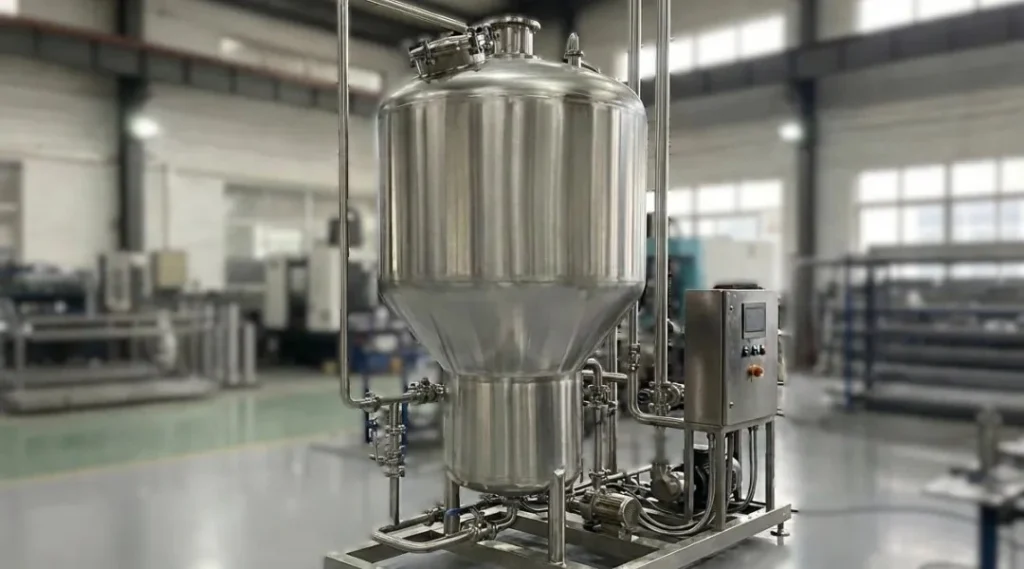
A tulip-shaped vessel—also referred to as a deep parabolic bottom vessel—is designed with a fundamentally different geometric philosophy.
Instead of ending in a shallow dish, the vessel shell continues inward in a smooth, tightening parabolic curve, gradually collapsing toward the outlet. The result is a bottom profile that resembles the bulb of a tulip—hence the name.
Key geometric characteristics include:
- Continuous curvature with no flat or shallow zones
- A single, clearly defined true low point
- An outlet that is integrated into the vessel geometry, not appended afterward
This is not a steeper cone or a hopper. It is a geometrically continuous liquid vessel, purpose-built for sterile applications.
Why Tulip-Shaped Vessels Improve Product Recovery
1. Near-Zero Hold-Up by Design
In a tulip-shaped vessel, gravity consistently directs liquid toward the outlet throughout the discharge cycle. Because there are no lateral pooling zones, product does not spread away from the drain.
The practical result is a dramatic reduction in residual volume—often from liters to mere milliliters.
For injectable manufacturers, this translates to:
- Higher recoverable yield per batch
- Reduced need for flushing or dilution
- Improved batch economics
Importantly, this improvement is achieved passively through geometry, not through operational workarounds.
2. Reliable Drainability for Sterile Operations
Drainability is not only a yield concern—it is also a hygienic design requirement.
Tulip-shaped vessels support:
- Predictable and repeatable drain-down
- Easier drainability qualification
- Improved CIP and SIP performance
Because liquid consistently evacuates the vessel, post-cleaning drainage is faster and more reliable, reducing the risk of microbial growth and simplifying validation activities.
3. Mixing Performance at Very Low Volumes
One of the most critical advantages of tulip-shaped vessels emerges at the end of the batch.
In standard vessels, once the liquid level drops below the impeller or mixing zone, suspension stability deteriorates. This creates a risk of non-uniformity precisely when product is about to be filled.
Tulip-shaped vessels are typically paired with bottom-mounted magnetic mixers positioned within the deep bottom bulb. This configuration allows effective mixing to continue even at 2–5% of total vessel volume.
The outcome:
- Uniformity maintained up to the final vial
- Support for variable batch sizes
- Reduced risk of content variability during filling
When Is a Tulip-Shaped Vessel the Right Choice?
Tulip geometry is not universally required, and it should not be treated as a default upgrade.
It is most appropriate when:
- Product value per batch is high
- Near-total recovery is expected
- Batch sizes are small or variable
- Mixing must remain effective at low volumes
- Sterility and cleanability are critical process requirements
For utilities, large-volume buffers, or non-sterile processes, standard dished vessels remain a practical and economical choice.
Geometry as a Process Decision
One common misconception is that vessel geometry is a fabrication detail. In reality, it is a process design decision with direct implications for yield, compliance, and lifecycle cost.
Unlike automation or procedural changes, geometry:
- Works every batch
- Does not depend on operator behavior
- Requires no additional validation effort once qualified
For sterile injectable manufacturers, tulip-shaped vessels often represent one of the highest-ROI equipment design decisions available.
Final Thought
Tulip-shaped vessels are not about aesthetics, trends, or marketing differentiation.
They exist because certain pharmaceutical processes demand:
- Near-zero hold-up
- Predictable drainage
- Low-volume mixing reliability
- Robust hygienic design
In those cases, the solution is not in the pump or the procedure—it is in the curve.