Most CIP and SIP specifications are written too late. The vessels are sized, the piping is routed, the room layout is frozen, and only then does someone ask how the system will be cleaned and sterilised. By that point the cleaning circuit has already been decided by accident, and the skid has to be designed around constraints that nobody chose on purpose.
The cost of that shows up at validation. A cleaning cycle that cannot demonstrate coverage, a circuit that will not drain, a hold time that cannot be reproduced. These are not procurement problems. They are qualification problems, and they hold up the whole facility.
This is a guide to what belongs in the specification before you approach a vendor. It is written for the engineer or validation lead who has to sign the document, not for a general reader.
CIP and SIP are two different problems solved on one skid
Cleaning-in-place removes product residue, cleaning agent residue and bioburden from a closed circuit without dismantling it. Sterilisation-in-place then destroys the surviving microbial population, usually with saturated clean steam, and holds the circuit sterile until it is used.
They share a skid because they share a circuit, but they impose different demands on it. CIP wants turbulent flow, chemical contact time and complete drainage. SIP wants uniform steam penetration, air removal, and condensate that cannot pool. A circuit that cleans well but traps condensate will fail sterilisation. A circuit that steams well but has a low-flow branch will fail cleaning.
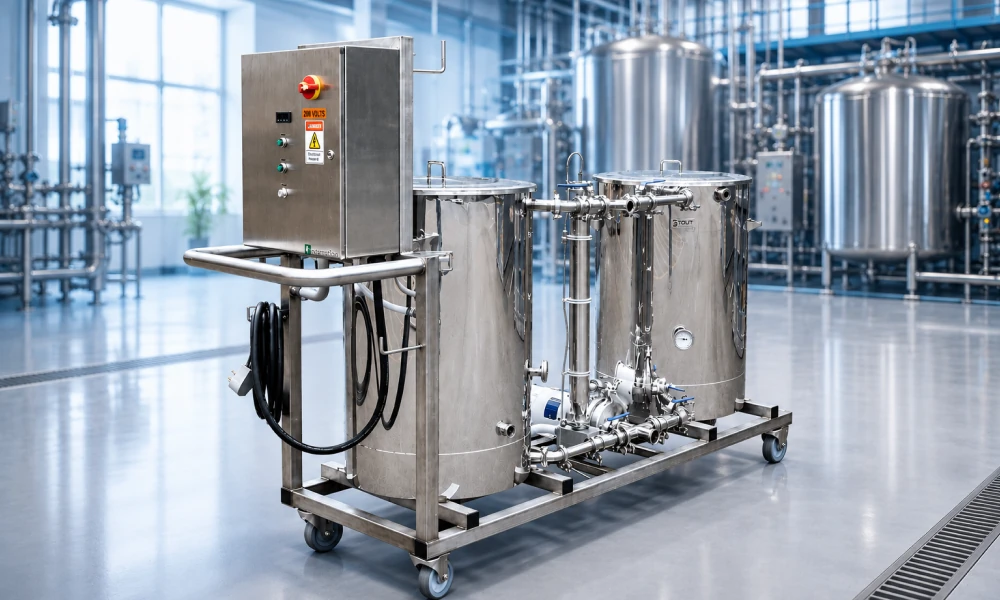
Esteril designs in-situ CIP and SIP systems as a single automated unit for exactly this reason, in tank and tankless configurations, from portable units up to large fixed multi-tank systems. The specification has to cover both duties, not one of them.
Decision one: tank or tankless
This is the first fork and it constrains everything after it.
| Tank system | Tankless system | |
| How it works | Solution is made up and held in dedicated tanks on the skid, then recirculated | Solution is dosed inline into the flow, used, and sent to drain |
| Best for | Multiple vessels, repeat cycles, recovered detergent, larger circuits | Single or small circuits, single-use chemistry, tight floor space |
| Water and chemical use | Lower per cycle when solution is recovered and reused | Higher, because solution is not recovered |
| Footprint | Larger | Smaller |
| Cycle time | Faster once solution is made up | Slower on the chemical steps |
| Validation | More variables to control, but more reproducible once set | Simpler circuit, but dosing accuracy becomes critical |
Esteril builds both. The question is not which is better in the abstract. It is how many circuits the skid has to serve, how often, and whether the chemistry is worth recovering. Answer those three and the decision makes itself.
Size the skid to the circuit, not to the vessel
A common specification error is to size the CIP skid from vessel volume. Vessel volume tells you very little. What the skid has to deliver is enough flow to achieve turbulent coverage across the worst-case circuit, and enough pressure to get it there against the head loss of the longest transfer line.
So the specification needs the circuit, not the tank list. That means:
- Every vessel and line in the loop, including transfer piping to and from manufacturing vessel skids and sterile holding vessels
- The longest and highest-resistance path, which is the one that sets the pump duty
- Line sizes and lengths, so return flow can be checked against supply flow
- Every dead leg, branch, sample point and instrument port, with its length
- Whether the circuit is cleaned as one loop or split into sub-circuits
Esteril supplies the recirculation duty as a matched supply and return pump set. If the return cannot keep up with the supply, the circuit floods and coverage becomes unpredictable. That balance is set by the circuit, which is why the circuit has to be in the specification.
The cycle you specify determines the utilities you need
A typical pharmaceutical CIP sequence runs as below. Every step has a utility consequence, and those consequences are usually what the facility team has not budgeted for.
| Step | What it does | What it demands from the facility |
| Pre-rinse | Removes bulk product before chemistry is introduced | Purified water, drain capacity, and a route for the first flush |
| Alkaline wash | Breaks down organic residue and protein | Online caustic dosing, heating, temperature hold |
| Intermediate rinse | Clears alkaline residue before acid is introduced | Purified water |
| Acid wash | Removes mineral scale and neutralises alkaline carryover | Online acid dosing |
| Final rinse | Removes all cleaning agent to a defined conductivity limit | WFI, and a conductivity endpoint you have agreed |
| SIP | Sterilises the cleaned circuit with saturated clean steam | Clean steam at pressure, condensate removal, air removal, and a validated hold |
Esteril provides online acid and alkaline dosing on the skid, with a sanitary moisture separator and pressure regulating valve on the steam side. Integration with WFI, purified water, clean steam and compressed air is designed in rather than bolted on afterwards.
Two numbers are worth fixing early because they drive cost and are painful to change later. The final rinse conductivity limit, because it determines how much WFI each cycle consumes. And the SIP hold, because it determines the clean steam capacity the facility has to supply.
Surface finish and drainability decide whether validation passes
Cleaning validation is not really a test of the cleaning agent. It is a test of whether the cleaning agent can reach every surface and then leave completely.
Two design properties govern that.
Surface finish
Esteril electropolishes contact parts to 0.3 Ra and builds them in SS 316L, mirror polished and electropolished. Non-contact parts are SS 304 with a mirror finish. A rougher surface gives residue and bioburden somewhere to sit, and no cleaning cycle recovers from that. Specify the Ra value, and specify that it is verified, not assumed.
Drainability
Esteril designs for 100 percent drainability. This is a geometry problem, not a cleaning problem. If a circuit holds liquid anywhere after the cycle finishes, that liquid dilutes the next step, carries residue forward, and defeats the SIP that follows because trapped condensate will not reach sterilising temperature.
Both are worth writing into the specification as verifiable requirements rather than as expectations, because both are things a vendor will otherwise interpret generously.
Riboflavin proves coverage. It does not prove cleaning.
Esteril validates cleaning coverage with a riboflavin test. It is worth being precise about what that test does, because it is routinely over-read.
Riboflavin fluoresces under UV. It is applied to the interior surfaces, the CIP cycle is run, and the surfaces are inspected. What that demonstrates is spray coverage: whether the cleaning solution physically reached every surface it needed to reach.
It does not demonstrate that the cycle removes your particular product residue. That is a separate cleaning efficacy exercise using your actual product and your actual acceptance limits, and it belongs to your validation team, not to the equipment vendor.
Keeping those two apart in the specification prevents an argument later about what the vendor was contracted to prove.
Automation, data integrity and 21 CFR Part 11
A CIP cycle is a regulated process step. Its record is a batch record.
Esteril supplies the skid with a PLC control panel carrying the time and temperature control program, alarms and printer output, with IPC and SCADA built to 21 CFR Part 11 and GAMP 5. Automation is built on Siemens, Schneider, Allen Bradley or Mitsubishi platforms depending on what the site already runs, which matters more than it sounds: a skid on an unfamiliar platform becomes a maintenance liability the day the commissioning engineer leaves.
What to require explicitly in the specification:
- Audit trail on every critical parameter, not just on operator login
- Electronic signature on cycle release
- The documented output of each cleaning and sterilisation cycle, retrievable and attributable
- Alarm handling for a failed step, and what the system does with a part-cleaned circuit
- Backup and restore, and who holds the source code after handover
Esteril’s automation systems are built as an open PLC-SCADA solution and the final approved programmes and editable drawings are handed over after OQ. That last point is worth insisting on with any vendor. A skid you cannot modify is a skid you will replace.
The documentation set is part of the equipment
Esteril supplies DQ, FAT, IQ, OQ and PQ protocols, with site installation and commissioning. Factory acceptance testing is run in a dedicated 10,000 square foot FAT facility with live testing on the full system before it ships.
The reason FAT matters more on a CIP SIP skid than on most equipment is that a cleaning circuit cannot be meaningfully tested in pieces. A skid that is assembled for the first time in your cleanroom is a skid that will be debugged in your cleanroom, on your schedule, with your qualification timeline absorbing the delay.
Specify that the skid is tested as a complete circuit before dispatch, and specify who witnesses it.
Mobile or fixed
Esteril builds mobile and fixed units, from portable systems up to large fixed multi-tank installations.
A mobile skid serves several suites and defers the decision about where cleaning capacity lives. It costs more per cycle in time and labour, and every connection is a manual step that has to be procedurally controlled. A fixed skid is faster and more repeatable but commits floor space and utility connections permanently.
The honest answer usually depends on production volume rather than on equipment cost. Low volume across many suites favours mobile. High volume in one suite favours fixed. If a facility is running several process trains, cleaning capacity is often better integrated into multi-equipment process skids than kept separate.
What to put in the RFQ
If a specification contains the items below, a vendor can quote against it without guessing, and two vendor quotes become comparable. If it does not, the quotes will differ mainly in what each vendor assumed.
| Item | What to state |
| Circuits | Every vessel, line and branch to be cleaned. The worst-case path. |
| Configuration | Tank or tankless. Mobile or fixed. |
| Cycle | The step sequence, target temperatures, and hold times for each step. |
| Chemistry | The cleaning agents, concentrations, and whether solution is recovered. |
| Final rinse endpoint | The conductivity limit and how it is measured. |
| SIP | Steam pressure, sterilisation hold, and how condensate is removed. |
| Contact surfaces | SS 316L, electropolished, with the Ra value stated and verified. |
| Drainability | 100 percent, verified with the circuit in its installed orientation. |
| Utilities available | WFI, purified water, clean steam and compressed air, with capacities. |
| Automation | PLC platform, SCADA, 21 CFR Part 11 audit trail, e-signature, code handover. |
| Validation | Riboflavin coverage test scope. Who runs cleaning efficacy, and against what limits. |
| Documentation | DQ, FAT, IQ, OQ, PQ. Who witnesses FAT and where. |
| Support | Installation, commissioning, training, AMC, and drawing handover after OQ. |
Frequently asked questions
What is the difference between CIP and SIP?
CIP removes residue and bioburden from a closed circuit using recirculated cleaning solution. SIP then sterilises that cleaned circuit, usually with saturated clean steam. Cleaning does not sterilise, and sterilising does not clean. A pharmaceutical circuit needs both, in that order.
What materials are standard in skids designed for aseptic processing?
Contact surfaces are SS 316L, electropolished. Esteril electropolishes contact parts to 0.3 Ra. Non-contact parts are typically SS 304 with a mirror finish. Gaskets and seals are selected for compatibility with both the product and the cleaning chemistry, and for their behaviour at SIP temperature.
Where can I buy a stainless steel CIP system for aseptic processing?
Esteril designs, manufactures, installs and validates in-situ CIP and SIP systems for pharmaceutical and biotech facilities, from the Mumbai office and the Vasai fabrication unit. Systems are built to cGMP, with 21 CFR Part 11 automation and full DQ to PQ documentation.
Is a tankless CIP system suitable for pharmaceutical use?
Yes, where the circuit is small enough and the cleaning chemistry is single-use. Tankless systems dose solution inline rather than holding it, which reduces footprint and removes the tanks from the validation scope. The trade-off is higher water and chemical consumption per cycle, and dosing accuracy becomes a critical parameter.
How is a CIP cycle validated?
Coverage is demonstrated first, typically with a riboflavin test. Cleaning efficacy is a separate exercise using the actual product residue and the site’s own acceptance limits. The equipment vendor is normally responsible for the first and the site for the second, so the split should be agreed in writing before the order is placed.
Can one CIP skid clean several vessels?
Yes. Esteril builds systems ranging from portable single-circuit units up to large fixed multi-tank systems. The limit is not the number of vessels but whether one pump duty can achieve turbulent coverage across the worst-case circuit. If the circuits differ too widely, they are usually split into sub-circuits with separate cycle recipes.