The pharmaceutical manufacturing and biopharmaceutical industries are evolving rapidly. Consequently, with increasing demand for efficiency, precision, and compliance, manufacturers are turning to automation to streamline operations while maintaining high-quality standards. As production requirements grow and regulations become stricter, it has become evident that automation plays a crucial role in ensuring both speed and safety. Moreover, automation allows for more consistent and reliable results, which are essential in today’s competitive market.
At Esteril, we specialize in designing, engineering, and manufacturing automated processing systems that are specifically tailored for the pharmaceutical sector. With years of expertise in the field, we provide innovative solutions that help pharmaceutical companies enhance production speed, improve accuracy, and ensure strict regulatory compliance. By adopting our automation systems, manufacturers can not only minimize human error but also boost productivity, reduce downtime, and maintain sterile conditions. These factors are all critical when it comes to producing safe and effective medicines, particularly in such a high-stakes industry.
In this blog, we’ll discuss:
What does automation mean in pharmaceutical manufacturing
How does it improve efficiency and quality
Types of automation systems used in the industry
The role of automation in regulatory compliance
How Esteril’s expertise can help your business
As you can see, automation is no longer a luxury but a necessity. Ultimately, it can save time, reduce costs, and create more efficient processes. Therefore, whether you are upgrading existing systems or building new ones, incorporating automation can lead to greater success in pharmaceutical manufacturing.
What Does Automation Mean in Pharmaceutical Manufacturing?
Automation in pharmaceutical and bio-pharmaceutical production refers to using machines, software, and technology to handle processes that would otherwise require manual work. This can include anything from automated drug formulation and sterile processing to packaging and quality control.
With automation, manufacturers can:
Ensure consistency – Every batch is produced under the same controlled conditions.
Reduce contamination risks – Less human contact means a lower chance of errors or exposure to contaminants.
Improve efficiency – Automated systems work faster and more precisely than manual operations.
Instead of relying on manual intervention at every step, automation helps companies produce high-quality medicines with greater speed and reliability.
How Automation Improves Efficiency and Quality in Pharmaceutical Manufacturing?
Automation isn’t just about replacing manual tasks; rather, it’s about making the entire manufacturing process more efficient and controlled. In fact, it plays a key role in enhancing productivity, reducing errors, and maintaining high-quality standards. Here’s how automation improves both efficiency and quality:
1. Faster Production Without Sacrificing Quality
- Automated systems can operate 24/7, thereby reducing downtime and significantly speeding up production. Consequently, this means companies can meet growing demand without compromising quality. Moreover, because machines do not experience fatigue, they ensure consistent results at all times.
2. Fewer Mistakes and Wastage
- Unlike manual processes, automated systems follow precise, programmed instructions, which drastically reduce human errors. As a result, there is less wasted raw material, which in turn leads to lower costs and higher output. Additionally, the ability to precisely control the process helps optimize resources, improving overall production efficiency.
3. Improved Cleanliness and Sterility
- In pharmaceutical manufacturing, maintaining a sterile environment is critical. However, automation can reduce human contact during production, which in turn lowers the risk of contamination. Not only does this improve sterility, but it also ensures compliance with strict regulatory standards.
4. Easy Scalability for Growing Businesses
- As production needs increase, automated systems can be easily scaled up without causing major disruptions. In fact, companies can quickly adjust their processes to meet new market demands, ensuring that they remain competitive. Furthermore, automation allows businesses to keep pace with increased production demands without sacrificing quality or efficiency.
Types of Automation Systems in Pharmaceutical Manufacturing
There are different types of automation, depending on the process it is used for. Let’s take a closer look at some of the key automation solutions used in pharmaceutical manufacturing.
1. Automated Filling and Packaging
- In this system, machines accurately fill capsules, vials, and bottles, ensuring the correct dosage. Moreover, automated labelling and sealing speed up the packaging process, thereby reducing errors and improving overall efficiency. As a result, this automation solution streamlines production, ultimately leading to faster output.
2. Clean-in-Place (CIP) and Sterilize-in-Place (SIP) Systems
- CIP systems clean processing equipment without requiring disassembly, which significantly reduces downtime. Similarly, SIP systems utilize steam sterilization to kill bacteria and ensure sterility, making them essential in maintaining hygienic conditions. By automating these processes, pharmaceutical manufacturers can ensure a consistently sterile environment, which is crucial for product safety.
3. Quality Control and Monitoring
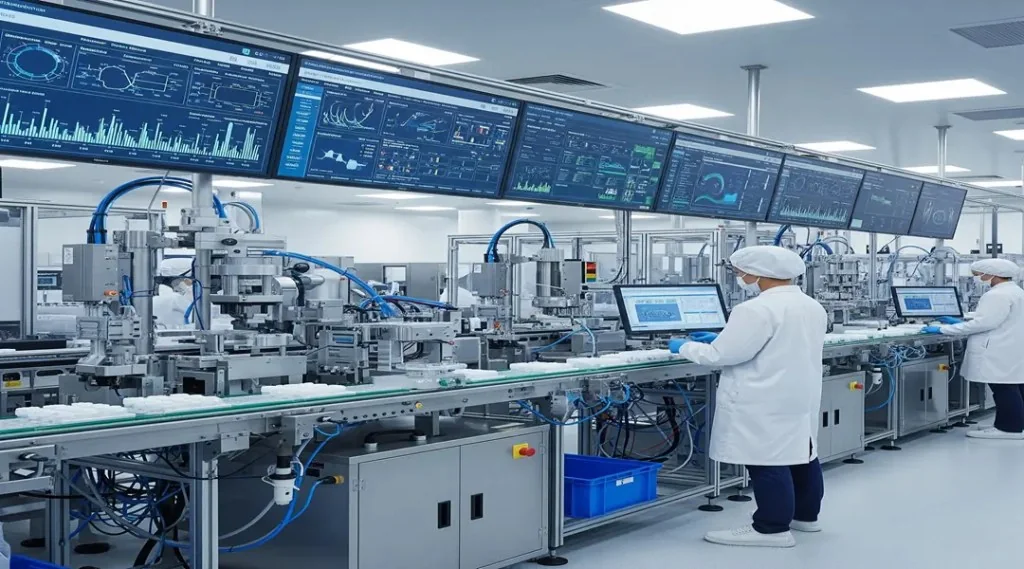
- Sensors continuously track temperature, pressure, and humidity in production areas, ensuring that the environment remains within optimal conditions. Furthermore, automated inspection systems detect defects in products before they reach the market, helping to ensure that only high-quality products are delivered. This real-time monitoring allows for immediate corrective action, ensuring compliance with industry standards.
4. Robotics in Material Handling
- Robotic arms are employed to safely and efficiently move raw materials and finished products. These automated systems not only prevent contamination but also reduce physical strain on workers, thereby improving workplace safety. In addition, robots help streamline workflows, ensuring that materials are handled quickly and without error.
5. Bioprocess Automation
- Bioprocess automation plays a crucial role in vaccine production and cell culture processing, ensuring that precise conditions are maintained. Consequently, it reduces the risk of errors in complex biological manufacturing processes, which can be costly and time-consuming if done manually. This automation helps increase consistency, quality, and overall productivity in biopharmaceutical production.
Automation and Regulatory Compliance
One of the biggest challenges in the pharmaceutical industry is meeting strict regulatory standards. Consequently, organizations like the FDA, EMA, and WHO have detailed guidelines that companies must follow to ensure drug safety and quality. In response, maintaining compliance has become not only a legal necessity but also a vital aspect of product integrity. Therefore, pharmaceutical companies must invest in systems that help them stay on track.
In this context, automation plays a crucial role in making compliance much easier. Specifically, it contributes to meeting regulatory requirements in several key ways:
Firstly, automation ensures that every step of the manufacturing process is recorded. This means that, as a result, detailed reports are automatically created for audits, reducing the manual work required and enhancing accuracy. Furthermore, automated systems maintain consistent production conditions, thus minimizing variations that could potentially lead to quality issues. For instance, precise control over temperature, humidity, and pressure helps keep production within regulated parameters.
Moreover, automation helps ensure data integrity. By removing human involvement from critical data collection, it prevents human errors or data tampering, which could otherwise jeopardize compliance and product quality. Therefore, automation not only enhances efficiency but also fortifies the company’s ability to adhere to ever-evolving regulatory standards. In conclusion, automated systems serve as a powerful tool for streamlining compliance and safeguarding product safety and quality.
How Esteril Helps You Automate Pharmaceutical Manufacturing
At Esteril, we design and build custom automation solutions tailored to the needs of pharmaceutical and biopharmaceutical companies. Whether you need a fully automated production line or a specific process upgrade, we have the expertise to help.
Here’s why companies trust us:
Deep Industry Knowledge
- We understand the unique challenges of pharmaceutical manufacturing.
- Our solutions are built to meet global regulatory standards.
Cutting-Edge Technology
- We integrate modern robotics, sensors, and control systems into your production lines.
- Our solutions improve precision, efficiency, and product consistency.
Customization for Your Needs
- Every company has different needs, so we design tailor-made automation systems.
- Whether you’re a small biotech firm or a large pharmaceutical company, we create solutions that fit your operations.
Full Support and Maintenance
- Our team provides installation, training, and long-term support.
- We make sure that automation systems run smoothly and efficiently.
FAQ’s
1. What Are the Different Types of Automation Used in Pharmaceutical Manufacturing?
- Automated Filling & Packaging Systems – Ensures accurate dosing and sterile packaging.
- CIP/SIP Systems – Automates cleaning and sterilization of equipment.
- Bioprocess Automation – Controls fermentation and cell culture conditions.
- Process Monitoring & AI Integration – Tracks real-time data for quality control.
- Robotics & Material Handling – Improves efficiency in drug manufacturing.
2. How does automation make pharmaceutical production more efficient?
By replacing manual processes with automated systems, robotics, and AI-driven monitoring, production lines run faster and with fewer interruptions. Machines can work 24/7 without fatigue, reducing downtime and increasing output. Plus, automated cleaning (CIP/SIP) and quality control processes ensure that each batch meets the same high standards.
3. Can automation help reduce contamination risks in pharmaceutical manufacturing?
Yes! Automation minimizes human contact with sterile environments, reducing the chance of contamination. Advanced robotic handling, automated filling, and sterilization systems ensure that products remain free from bacteria, particles, or human-introduced contaminants. This is especially important in vaccine production and biologics manufacturing.
4. What are some common automated systems used in the pharmaceutical industry?
Some key automation systems include:
- Filling and packaging machines – Ensure precise dosing and reduce waste.
- CIP/SIP (Clean-in-Place & Sterilize-in-Place) systems – Maintain hygiene without manual cleaning.
- Bioprocess automation – Controls temperature, pH, and nutrient supply for biologics.
- AI-driven monitoring – Detects potential quality issues before they become costly problems.
- Robotic arms and conveyors – Improve material handling and reduce strain on workers.
5. Is automation only for large pharmaceutical companies, or can smaller companies benefit too?
Automation is not just for big pharmaceutical companies. It also benefits small manufacturers in quality control, packaging & cleaning. Many automation solutions are modular and scalable, meaning companies can start small and expand as needed.
Conclusion
Automation was used to be a luxury but now it’s a necessity for pharmaceutical and bio-pharmaceutical companies who wants to improve efficiency, maintain sterility, and meet regulatory requirements. With automation, manufacturers can reduce errors, speed up production, and ensure product consistency. At Esteril, we deal in tailored automation solutions that help companies modernize their manufacturing operations. If you’re looking for ways to improve your production efficiency while ensuring compliance, our team is ready to help.
Want Help Choosing the Right Vessel?
At Esteril, we design and build GMP-compliant pharmaceutical manufacturing vessels tailored to your exact needs.
- Precision-engineered
- Regulatory-ready
- Backed by technical support
Contact us today to request a quote or consultation. Please find our LinkedIn profile for the latest updates