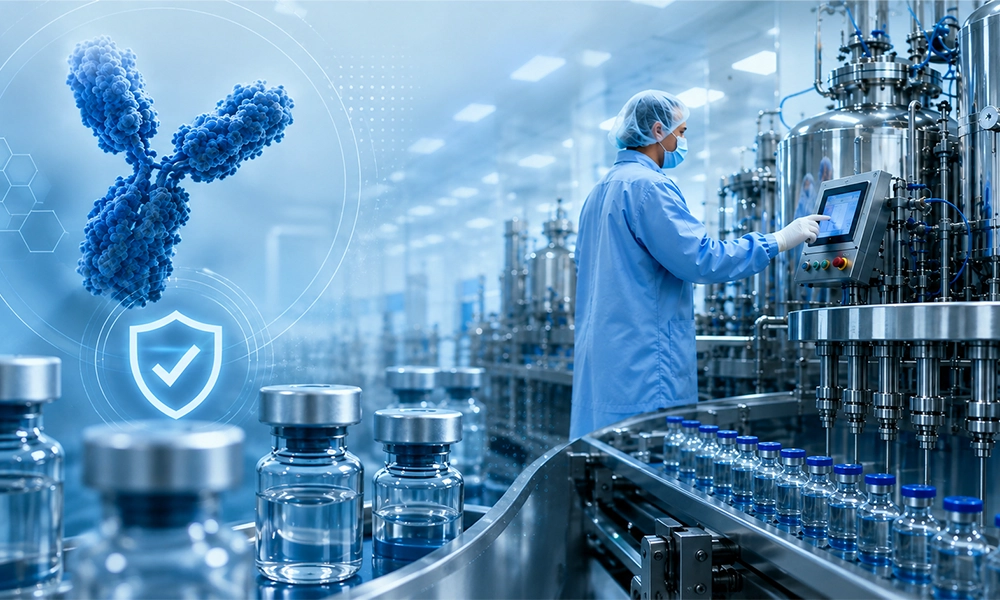
Biosimilar pipelines are expanding across both regulated and emerging markets. Approval pathways at the US FDA, the EMA and India’s CDSCO have matured, and the number of approved biosimilars grows each year. That is good news for manufacturers and for patients. Approval, though, is a threshold, not a finish line. Producing a biologic sterile, at commercial scale, batch after batch and across sites, is a separate and sustained engineering discipline. The sterile process equipment specified for a facility, and the process design behind it, decides whether a biosimilar programme scales reliably or stalls after launch.
Why Biosimilar Scale-Up Requires More Than Regulatory Approval
Biosimilars are not small molecules. They are large, complex biologics such as monoclonal antibodies, fusion proteins and pegylated compounds, produced through living cell systems that carry inherent variability. Process parameters validated at clinical-batch scale do not automatically hold at commercial scale, particularly across filtration and the steps that feed fill-finish. The sterility assurance risks that appear at scale are layered, and they are often underestimated during early planning.
| Risk area | What it means at commercial scale |
|---|---|
| Scale-up integrity | Filtration and fill-finish parameters proven at lab scale need requalification at manufacturing volumes. |
| Facility contamination control | Cleanroom design, airflow, pressure differentials and gowning must be engineered for biologics production, not assumed. |
| Validation burden | Each item of process equipment must be qualified through IQ, OQ and PQ, with sterilisation cycles validated to regulatory standards. |
| Contamination recovery | A sterility failure is not only product loss. It triggers batch rejection, investigation cycles and regulatory scrutiny. |
India’s biosimilar moment raises the process bar
India is becoming a serious player in the global biosimilars landscape, with several manufacturers already exporting to regulated markets in the US and Europe. That achievement brings closer scrutiny of manufacturing standards. Regulatory inspections of sterile facilities consistently focus on aseptic practice, environmental monitoring and contamination control strategy. For Indian manufacturers competing in regulated markets, this raises the need to close the gap between approval-readiness and day-to-day operational control. Winning an approval is a milestone. Sustaining sterile manufacturing at commercial scale is the harder and more durable capability.
How Esteril approaches sterile process design for biopharma
Esteril Process Solutions works with pharmaceutical and biopharmaceutical manufacturers on the process engineering that sits between regulatory approval and consistent commercial production. Sterility is treated as a design parameter from the start of a project, not a control added later.
Sterile process design built in from the start
Process systems are engineered with contamination control designed in, from equipment layout through CIP/SIP integration. The intent is that sterility is addressed in the design itself, rather than retrofitted once equipment is in place.
Equipment specification and qualification support
For teams scaling up, the specification of process equipment carries real weight. Esteril helps clients specify and qualify process equipment in line with regulatory expectations, with engineering documentation structured to support IQ, OQ and PQ.
Filtration, sterile transfer and the run into filling
Esteril supports the critical process steps that lead into filling, including filter selection, sterile transfer and hold-time considerations, and the integration of upstream process equipment with the filling operation.
Regulatory-aligned documentation
Projects are structured with inspection readiness in mind. Engineering documentation is prepared to support regulatory submissions and facility inspections rather than add friction to them.
Direct engagement across the project lifecycle
Esteril engages directly with client technical teams and stays accountable across the project lifecycle, from design and FAT through installation, commissioning, validation and support.
Frequently asked questions
What makes sterile manufacturing harder for biosimilars than for small-molecule drugs?
Biosimilars are large biologics produced in living cell systems, so they carry more process variability and are more sensitive to contamination. Parameters validated at small scale, especially in filtration and the steps leading into fill-finish, often need requalification when production moves to commercial volumes.
Does contamination control need to be designed in early?
Yes. Cleanroom design, airflow, pressure differentials and CIP/SIP integration are more effective and less costly when engineered into the process from the start, rather than added after equipment selection.
What compliance standards should biosimilar process equipment meet?
Sterile process equipment for biosimilar manufacturing is typically expected to align with cGMP, 21 CFR Part 11 for electronic records and signatures, and GAMP 5 for automated systems, supported by qualification through IQ, OQ and PQ.
Can process equipment be qualified faster without compromising compliance?
Qualification cannot be shortcut. Clear specifications and inspection-ready documentation prepared alongside the equipment help IQ, OQ and PQ proceed with fewer gaps and less rework.
Approval gets a biosimilar to market. Sterile process capability keeps it there.
The biosimilar opportunity in India and globally is real and growing, but opportunity without process infrastructure is fragile. Manufacturers who treat sterility engineering as a strategic capability, rather than only a compliance requirement, are the ones positioned to scale reliably. If you are planning a new biosimilar facility, a scale-up, or a contamination-control review, Esteril can support the process engineering behind it.
Explore Esteril’s Complex Process Skid and In-Situ CIP/SIP Systems, or contact the team to discuss your project.