Digital twins in sterile pharma manufacturing are gaining attention as the industry moves toward smarter, data-driven operations. From automation to AI, manufacturers are exploring ways to improve efficiency, reliability, and compliance.
Among these advancements, digital twins have become one of the most talked-about concepts—often positioned as a key pillar of Industry 4.0.
But beyond the discussions and projections, a more grounded question remains:
How relevant are digital twins in the day-to-day reality of sterile pharma manufacturing?
For decision-makers and engineers, the answer lies somewhere between opportunity and practicality.
Understanding Digital Twins – Without the Hype
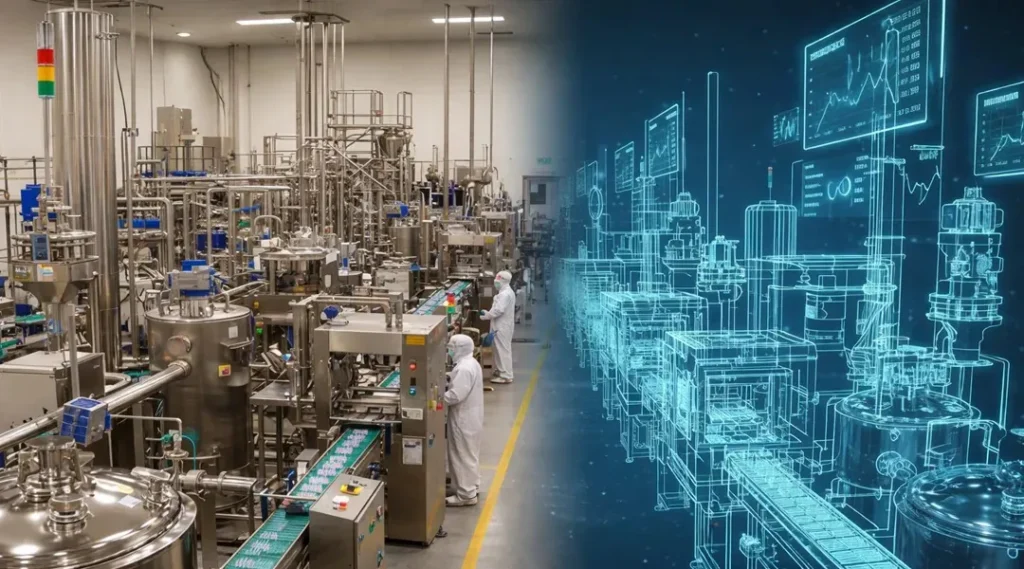
A digital twin is essentially a virtual representation of a physical system that is continuously updated using real-time data.
In a sterile pharmaceutical setup, this could involve creating a digital model of:
- A process skid
- A mixing or holding vessel
- Clean utility systems
- Or even an entire production line
The objective is to mirror real-world operations digitally, allowing teams to monitor performance, analyse behaviour, and simulate potential changes without affecting actual production.
Benefits of Digital Twins in Sterile Pharma Manufacturing
When implemented effectively, digital twins can offer meaningful advantages:
Predictive Maintenance
By analyzing real-time data patterns, potential equipment failures can be identified before they occur—reducing unplanned downtime.
Process Optimization
Teams can simulate parameter changes and evaluate outcomes without interrupting ongoing production, minimizing trial-and-error.
Improved Visibility
A centralized digital model provides a clearer understanding of system performance, especially in complex sterile environments.
Faster, Data-Driven Decisions
With access to real-time insights and predictive analytics, operational decisions can be made with greater confidence.
Challenges of Digital Twins in Sterile Pharma Manufacturing
Despite their potential, digital twins are not yet a plug-and-play solution for most pharma facilities.
Data Reliability Comes First
Digital twins depend entirely on accurate and continuous data.
In reality, many plants still face incomplete data capture, manual interventions, and legacy systems with limited sensor integration.
Integration Complexity
Sterile manufacturing systems involve multiple interconnected components.
Integrating them into a unified digital framework requires strong automation infrastructure and standardized data architecture.
Validation and Compliance Considerations
Any system influencing process performance must meet strict validation requirements.
This creates challenges in validating continuously evolving digital models within GMP frameworks.
Cost vs Immediate Value
The investment required for digital twins is significant.
For many organizations, immediate ROI may not justify full-scale implementation.
What Matters Most Today
While digital twins represent a forward-looking capability, most pharmaceutical manufacturers today are focused on strengthening core operational areas:
- Reliable and well-designed process equipment
- Robust automation and control systems
- Consistent data capture and traceability
- Ease of operation and maintenance
These fundamentals are critical, not just for current performance, but for enabling future digital transformation. This becomes especially important in systems like SIP systems and CIP technology, where consistency and sterility are essential.
Building the Right Foundation for Digital Transformation
While technologies like digital twins are shaping future conversations, their effectiveness ultimately depends on the strength of the underlying systems.
In practice, this comes down to getting the fundamentals right, well-designed process equipment, reliable automation, and consistent data capture.
At Esteril Process Solutions, the focus has been on enabling exactly this.
By delivering:
- Well-engineered process skids designed for consistent performance
- Automation-ready systems that support seamless integration
- Reliable data capture that improves visibility and control
organizations are better positioned to adopt advanced digital solutions when the time and context are right.
A More Practical Way Forward
Rather than approaching digital twins as an immediate requirement, it may be more effective to see them as part of a gradual evolution.
A practical pathway includes:
- Strengthening equipment design and reliability
- Improving automation and data collection
- Ensuring data integrity and standardization
- Building analytical capabilities
- Gradually introducing predictive tools
Closing Perspective
Digital twins represent a meaningful shift toward more intelligent, data-driven manufacturing.
However, in sterile pharma environments, where precision and compliance are critical, readiness matters more than ambition.
Strong engineering fundamentals remain the foundation of any successful digital transformation.