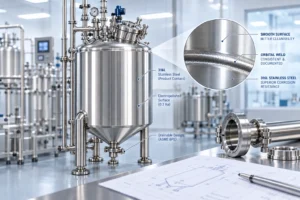
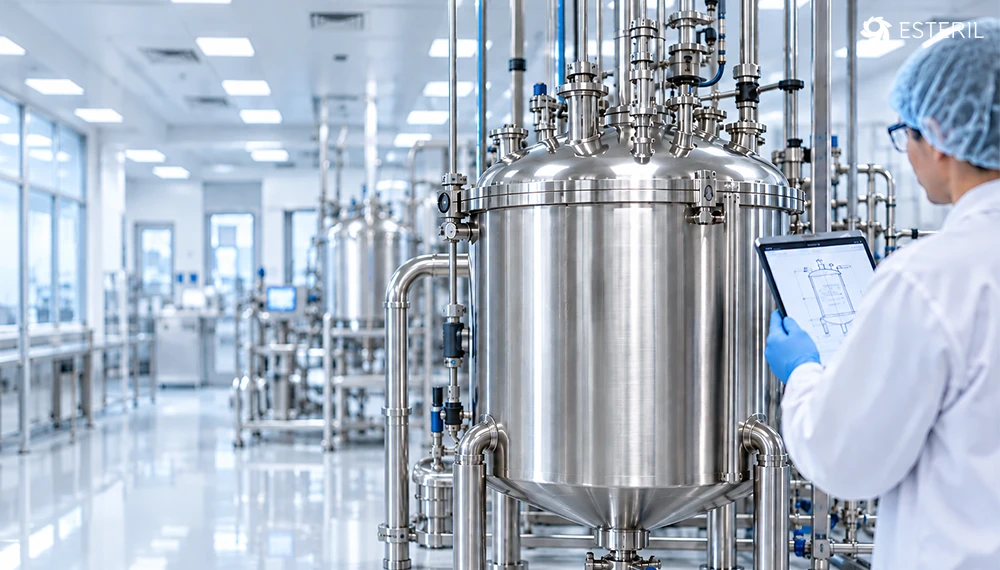
A sterile manufacturing vessel can look identical to a general-purpose stainless steel tank and behave completely differently once it is in a cleanroom. The difference is not in what you can see. It is in the surface finish, the welds, the material grade, and the internal geometry, and those details are what ASME BPE sets out to control.
This guide explains what the standard covers, why ordinary stainless fabrication falls short for sterile and injectable production, and what to require when you specify a vessel. It is written for the engineers and procurement teams choosing equipment, and for the QA and validation leads who will be audited against the standard the vessel was supposed to meet.
What ASME BPE is, and what it is not
ASME BPE is the Bioprocessing Equipment standard published by ASME. It covers the design, materials, surface finish, welding, and documentation of equipment that contacts product in pharmaceutical and biopharmaceutical manufacturing.
It is worth being precise about its status. ASME BPE is a consensus standard, not a law. No statute names it. What cGMP does require is that equipment surfaces are cleanable and do not contaminate the product, and ASME BPE is the recognised way to demonstrate that in the way a vessel is designed and built. Buyers specify it, and auditors expect to see the documentation behind it. For an injectable line, meeting it is not really optional, even though no regulation lists it by name.
Why ordinary stainless fabrication falls short
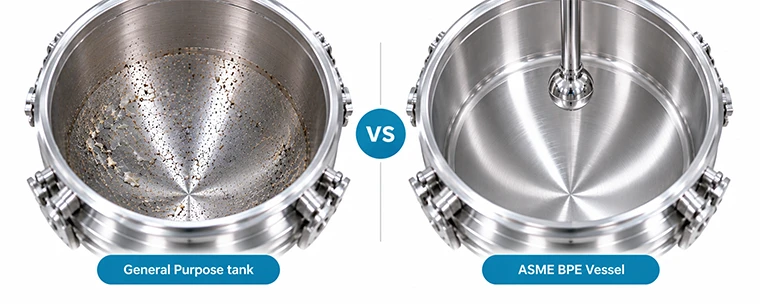
A general-purpose tank can be structurally sound and still be wrong for sterile production. Rough surfaces, tight crevices, and inconsistent welds give product residue and microorganisms places to lodge. In sterile manufacturing, anything that holds residue is a cleaning failure and a contamination risk, and the vessel has to clean to a validated standard cycle after cycle.
This is why the standard concentrates on the microscopic and geometric detail rather than on pressure rating alone. The question is not only whether the vessel holds its contents. It is whether it can be cleaned, drained, and documented to a level an auditor will accept.
Surface finish, and why Ra matters
Ra is the arithmetic average roughness of a surface. A lower Ra means a smoother surface, with fewer microscopic peaks and valleys where soil and microorganisms can settle, and it drains more cleanly. ASME BPE defines surface finish designations with maximum Ra values for product-contact surfaces.
Electropolishing takes this further. It removes a thin surface layer and leaves a chromium-enriched passive layer that resists corrosion and reduces how much the surface interacts with the product. Esteril electropolishes product-contact parts on its vessels and skids to 0.3 Ra, which sits within the smoother end of the range specified for sterile service.
Orbital welding and the record behind each weld
Manual welds vary from one joint to the next and can leave discoloration, crevices, and uneven penetration, each of which becomes a contamination trap. Orbital welding automates the process. A controlled rotating head produces consistent, repeatable welds, and the parameters are recorded, so weld logs and test coupons support the documentation the standard and the client expect. An inert gas purge protects the inside surface from oxidation as the weld is made.
Esteril fabricates with orbital welding and supplies the weld documentation alongside the vessel, which is what lets a buyer verify weld quality rather than take it on trust.
Material, geometry, and drainage
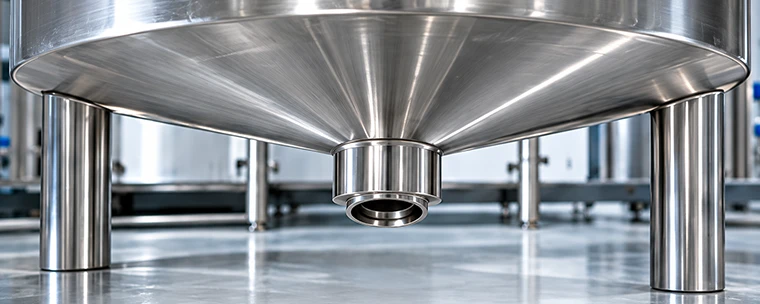
316L stainless steel is the common product-contact material for sterile vessels. Its low carbon content reduces carbide precipitation during welding, which protects corrosion resistance exactly where welds concentrate stress and heat.
Geometry does the rest. Sloped bottoms and drainable routing let the vessel empty fully, and keeping branch runs short relative to their diameter reduces the stagnant zones where cleaning fluid can pool. Passivation after fabrication restores the passive layer across the finished surface. None of this is visible in a photograph of a finished tank, which is exactly why it has to be specified and documented.
What to require when you specify a sterile manufacturing vessel
If you are writing a user requirement specification, these are the areas where the difference between a compliant vessel and a merely well-built one is decided.
| Specification area | What to require | Why it matters |
|---|---|---|
| Product-contact material | 316L stainless steel with material certificates | Low carbon content protects corrosion resistance at the welds |
| Surface finish | A defined maximum Ra on contact surfaces, electropolished | Fewer microscopic sites for soil and microbes; better drainage |
| Welding | Orbital welding with weld logs and test coupons | Consistent, documented, crevice-free joints |
| Geometry | Drainable design, sloped bottom, short branch runs | Vessel empties fully and stagnant zones are reduced |
| Documentation | Material certs, weld maps, surface records, DQ/IQ/OQ/PQ | Audit readiness and a validated cleaning basis |
| Standard reference | ASME BPE cited explicitly in the URS | A benchmark both buyer and builder can verify against |
The standard is only as strong as the documentation behind it
A vessel can be fabricated to a high standard and still fail an audit if the material certificates, weld maps, surface finish records, and qualification protocols are not there to prove it. The documentation is not paperwork after the fact. It is the evidence the vessel is what the specification asked for.
Esteril supplies DQ, IQ, OQ, and PQ documentation with material and weld records, and works across the full project, from design through FAT and SAT, installation, commissioning, validation, and support. That is what turns a compliant build into a vessel a QA team can defend in an inspection.
Frequently asked questions
Is ASME BPE legally required for pharmaceutical vessels?
No single law names it. cGMP requires equipment that is cleanable and does not contaminate the product, and ASME BPE is the standard buyers and auditors use to confirm that in practice. For sterile and injectable production it is effectively expected, even though it is not itself a statute.
What surface finish does a sterile vessel need?
It depends on the product and the buyer’s specification. Product-contact surfaces are typically electropolished to a defined maximum Ra. Esteril electropolishes contact parts to 0.3 Ra.
316 or 316L, does the L matter?
Yes. The lower carbon content of 316L reduces carbide precipitation during welding, which protects corrosion resistance at the welds, where it matters most in a vessel that will be cleaned and sterilised repeatedly.