An aseptic holding tank has one job: hold product between process steps without changing it and without contaminating it. Whether it does that reliably depends heavily on the material in contact with the product and how the surface is finished. SS 316L is the standard choice for good reasons, but naming the grade does not settle the question. Two tanks both built in 316L can behave very differently depending on how the surface is treated and how well the material is matched to the product.
This guide covers the material and surface side of that decision: why 316L is the default, how product chemistry interacts with the surface, and what electropolishing and passivation actually do. It pairs with our guide on ASME BPE for sterile vessels, which covers welding, geometry, and documentation, so this piece stays focused on material.
Why 316L is the default, and what the L means
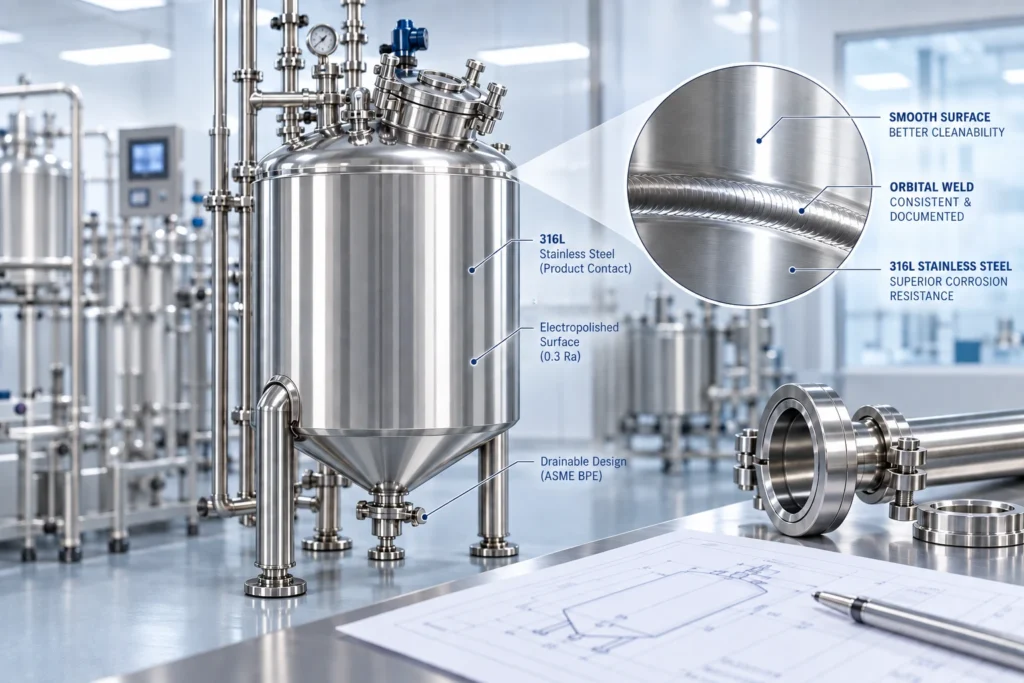
316L is an austenitic stainless steel. Its molybdenum content gives it better resistance to chlorides and pitting than 304, and the low carbon content, the L, reduces carbide precipitation during welding, which protects corrosion resistance at the welds. For most sterile pharmaceutical products, 316L on contact surfaces with 304 for non-contact structure is the workhorse combination, and it meets the requirement.
Esteril builds to this combination as standard: contact parts in SS 316L, non-contact parts in SS 304. The point of this article is not to move away from 316L. It is to make sure the surface and the material are matched to the product rather than chosen by habit.
How product chemistry interacts with the surface
Not every product is equally benign to stainless steel. Chloride-bearing solutions, low pH, and certain process conditions raise the risk of pitting and crevice corrosion, even in 316L. That matters more in an aseptic holding tank than it might elsewhere, because a corroding surface is not just a maintenance problem.
A surface that corrodes can shed metal ions into the product and create pits and crevices that harbour residue and microorganisms. In aseptic holding, that is a product-quality and contamination risk, not just wear. The material has to be matched to the actual product and cleaning chemistry, which is why the selection should start from what the tank will hold, not from a default grade.
What electropolishing actually does
Mechanical polishing smooths the surface. Electropolishing goes further. It removes a thin surface layer, evens out the microscopic peaks and valleys, and leaves a surface enriched in chromium. That chromium-rich passive layer is what resists corrosion and reduces how much the surface interacts with the product. A smoother surface also gives soil and microbes fewer places to settle and drains more cleanly.
Esteril electropolishes contact parts to 0.3 Ra, which sits within the smoother end of the range specified for aseptic service. Electropolishing is not a cosmetic step. It is part of how the material delivers its corrosion resistance and cleanability.
Passivation, the step people skip
After fabrication, welding and handling can leave the surface with free iron and a depleted passive layer, which is exactly where corrosion starts. Passivation is a controlled chemical treatment that removes free iron and restores the chromium-rich passive film across the finished surface. Without it, even 316L can corrode at welds and worked areas. For aseptic service it is a required step, not an optional one, and it should be documented with passivation records.
When 316L is not enough
It is worth being honest about the limits. For some chemistries, particularly high chloride, aggressive halides, or certain acids at temperature, 316L may not be the right material, and a higher alloy such as a higher-molybdenum stainless or a nickel alloy is evaluated instead. This is a project-specific engineering decision driven by the product and process, not a default upgrade to reach for on every job.
The right approach is to assess the actual product chemistry, cleaning agents, temperature, and duty against material compatibility before specifying, rather than choosing 316L because it is standard and discovering the mismatch in service. Where a project’s chemistry calls for material selection beyond 316L, that is a design-stage conversation to have early, with the product data on the table.
A material selection checklist for an aseptic holding tank
| Factor | What to assess | Why it matters |
|---|---|---|
| Product chemistry | pH, chloride and halide content, reactivity | Drives the risk of pitting and crevice corrosion |
| Contact material | 316L as the baseline; a higher alloy only if the chemistry demands it | Corrosion resistance and product purity |
| Surface finish | A defined Ra on contact surfaces, electropolished | Cleanability and fewer sites for residue and microbes |
| Passivation | Confirmed after fabrication, with records | Restores the passive layer that gives 316L its corrosion resistance |
| Cleaning agents | Compatibility of the CIP chemistry with the surface | Aggressive cleaning can attack a poorly chosen material |
| Documentation | Material certificates, finish and passivation records | Evidence for validation and audit |
The material decision is made once and lived with for years
You cannot easily change the contact material of an installed tank. Getting it right at specification, matched to the product and the cleaning chemistry, is far cheaper than finding a corrosion or contamination problem after the tank is in service and qualified. The cost of a wrong material choice is not only the tank. It is the downtime, the investigation, and the requalification.
Esteril fabricates aseptic holding vessels in electropolished 316L with full material and finish documentation, and works across the project lifecycle from design through validation, so the material choice is made with the product and cleaning chemistry in view rather than after the fact.
Frequently asked questions
Is 316L good enough for an aseptic holding tank?
For most sterile pharmaceutical products, yes, when the surface is properly finished and passivated. For aggressive chemistries such as high chloride or halide content, the material should be assessed against the product before defaulting to 316L.
What is the difference between polishing and passivation?
Polishing, whether mechanical or electropolishing, controls surface roughness. Passivation is a chemical treatment that removes free iron and restores the chromium-rich passive layer that resists corrosion. A tank needs both, and one does not replace the other.
Does electropolishing prevent corrosion?
It improves corrosion resistance by leaving a smoother, chromium-enriched surface, and it reduces the sites where residue and microbes settle. It works alongside the right material choice and passivation, not as a substitute for either.