On 20 March 2026, the Indian patents on semaglutide expired. Within weeks, generic versions were on the market. By May, at least ten Indian manufacturers had launched under more than 20 brand names, and patent expiries in Canada, Brazil and China this year are opening further markets.
The launches were the visible part. The engineering work behind them is still going on. Companies that launched on day one are now scaling up, and those that did not are planning lines of their own. For engineering and project teams, the question has moved from “can we make it” to “what do we specify for commercial formulation”.
This article covers what to put in the specification for the formulation vessel and skid on a GLP-1 or peptide injectable line. It does not cover formulation science. Your process development team defines the parameters. The equipment’s job is to hold them, batch after batch, and to prove it.
Why the formulation stage deserves close attention
Peptide injectables such as semaglutide are high-value products made in comparatively small batches. That changes the economics of the formulation stage. Product left behind in a vessel, a line or a filter housing is expensive. A transfer that is out of tolerance can mean a rejected batch. And on a multi-product or campaign line, every changeover has to be cleaned, verified and documented before the next batch starts.
Each of those points maps to a decision in the equipment specification.
Batch size, holdup and transfer accuracy
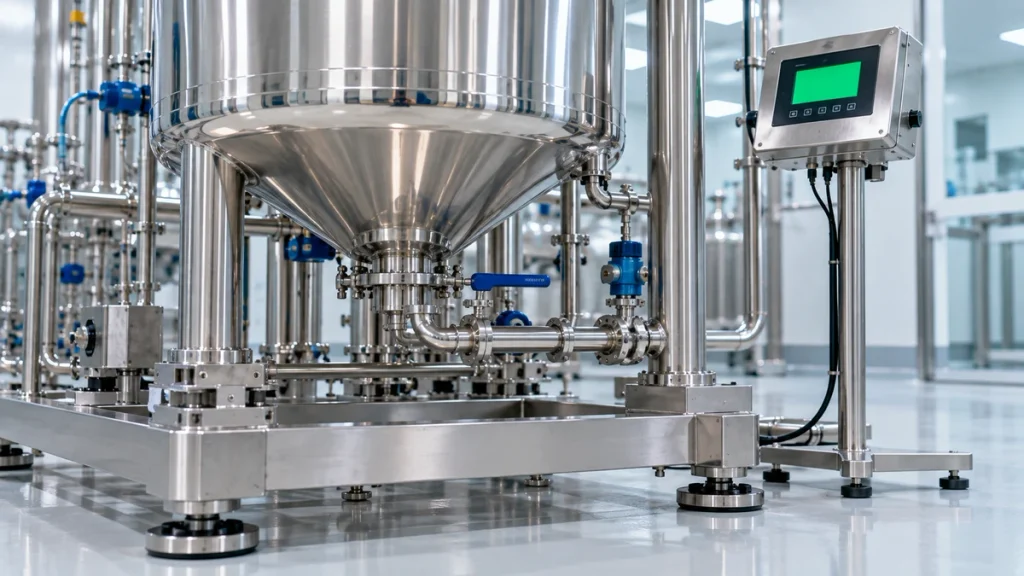
Start with the numbers your process development team has given you: batch volume, the range of concentrations you expect to run, and the transfer tolerance between vessels. Size the vessel to the working volume you need, not the largest batch you might run someday. An oversized vessel adds surface area, which can mean more holdup and more to clean.
Transfer accuracy is where a weighing system earns its place. Esteril’s manufacturing vessels can be mounted on load cells for precise transfer, so the quantity moved from one vessel to the next is measured rather than estimated. For high-value peptide batches, that measured record also supports your batch documentation.
See our manufacturing vessel skids.
Contact surfaces and material traceability
Every surface that touches the product needs a known material and a known finish, backed by records. At Esteril, contact parts are SS 316L, electropolished up to 0.3 Ra, and non-contact parts are SS 304. Materials are checked in Esteril’s on-site QA/QC laboratory as part of fabrication, and piping is joined with orbital welding.
When you write the specification, state the surface finish you need and ask for the records that prove it. A finish that is not documented is difficult to defend in a regulatory inspection.
Mixing: match the agitator to the formulation
There is no single correct agitator for peptide injectables. The right choice depends on your formulation, the excipients, the order of addition and the volume. That information comes from process development, and it should be written into the specification rather than left to the equipment supplier to assume.
Esteril vessels can be built with bottom driven or top driven stirrers, or with a high shear mixer where the process needs one. Tell your supplier what the formulation needs, such as speed range, mixing time, and any limits your development team has set, and ask how the proposed configuration meets it.
Temperature control and monitoring
If your process has a defined temperature range for compounding or holding, the vessel needs to hold that range and record that it did. Esteril’s mixing and holding vessels are engineered for cleanroom environments with temperature control and monitoring. Specify the range, the tolerance and how the data should be recorded, so it can form part of the batch record.
CIP/SIP for campaign changeovers
Generic peptide lines often run in campaigns, switching between strengths or products. Each switch depends on cleaning that is effective and can be shown to be effective. An automated CIP/SIP system is the most practical way to achieve that, because every cycle runs the same way and produces a record.
Esteril builds CIP/SIP systems in automated or semi-automated form, with PLC time and temperature control, online acid and alkaline dosing, and a documented output for every cleaning and sterilisation cycle. Cleaning coverage is verified with a riboflavin test, and systems are designed for drainability, verified during FAT. See our CIP/SIP systems .
Automation and batch records
For products headed to regulated markets, the automation around the formulation skid matters as much as the steel. Esteril’s automation is built to USFDA 21 CFR Part 11 and GAMP 5 guidelines, with electronic batch records, an audit trail, a backup facility and centralised HMI or IPC control, on Siemens, Schneider, Allen Bradley or Mitsubishi platforms.
What to put in your URS
A clear User Requirement Specification saves weeks of back and forth. For a peptide injectable formulation skid, cover at least these points:
| URS item | What to specify |
| Batch volume | Working volume range, not only the maximum |
| Transfer | Transfer route and tolerance, and whether weighing is required |
| Contact materials | Grade of steel and required surface finish, with records |
| Mixing | Agitator type and operating range from process development |
| Temperature | Range, tolerance and how data is recorded |
| Cleaning | CIP/SIP cycle requirements and cleaning validation method |
| Automation | Part 11 functions: audit trail, EBR, access control, backup |
| Qualification | DQ, FAT, IQ, OQ and PQ scope, and FAT witness plan |
FAT for Esteril systems is carried out at a dedicated testing facility of more than 10,000 sq ft before shipment, so your team can see the skid run before it reaches site. Read our guide to FAT and SAT .
Frequently Asked Questions
What should a URS for a GLP-1 formulation skid include?
Batch volume range, transfer route and tolerance, contact materials and finish, mixing requirements, temperature range, CIP/SIP requirements, automation functions and the qualification scope. The table above can be used as a starting point.
Can we witness the skid running before delivery?
Yes. Esteril carries out FAT at its dedicated testing facility, and customer teams can witness it before the system is shipped.
Which automation platforms can the skid run on?
Siemens, Schneider, Allen Bradley or Mitsubishi, depending on your site standard.