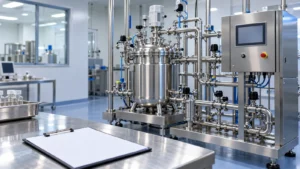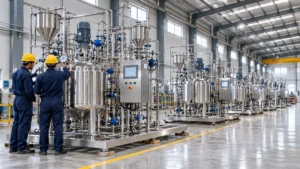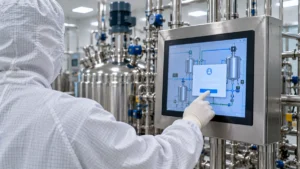
A sterile holding vessel has the least glamorous job in a sterile facility and one of the least forgiving ones. It does nothing to the product. It simply has to keep an expensive, already-sterile bulk solution exactly as it is, sterile, for a defined period, and then hand it over to the next step unchanged.
Failure at that point is expensive in a specific way. The product has already absorbed the full cost of compounding and filtration. There is nothing downstream that can recover it. A holding vessel that loses sterility loses the whole batch.
This guide covers what belongs in the specification.
What a holding vessel does that a manufacturing vessel does not
These two are routinely specified as though they were the same equipment with different labels, and they are not.
A sterile manufacturing vessel is designed to act on the product. It mixes, compounds, heats and disperses. Its agitation is sized to do work.
A sterile holding vessel is designed to act on the product as little as possible, for as long as required, without letting anything in. Its agitation, if any, exists only to prevent settling or stratification. Its real specification is the sterile boundary and the hold time.
Esteril builds sterile holding vessels and skids across 3 to 25,000 litres, tailored to client and product specification, with all equipment integrated into a single system.
Hold time is the specification
Everything else follows from it.
A validated hold time is a claim that after N hours in this vessel, under these conditions, the product is still sterile and still within specification. That claim has to survive an inspection, which means every parameter that could have changed during those N hours has to have been controlled and recorded.
- Temperature, held rather than merely monitored, for the full duration
- Sterile boundary integrity, including the vent path, for the full duration
- Product stratification or settling, and whether gentle agitation is needed to prevent it
- Headspace management, including whether a nitrogen or inert overlay is required
- The recorded evidence for all of the above, attributable and retrievable
The most common gap is that the hold time is validated in a study and then not enforced by the control system in routine use. If the vessel can physically hold product past the validated limit without alarming, it eventually will.
The sterile boundary is mostly the vent
Product enters the holding vessel already sterile. It leaves sterile. In between, the vessel is closed. So the interesting question is where the boundary can be breached, and the answer is usually the point where the vessel has to breathe.
As product is drawn out, air has to come in, and that air path is a direct route into a sterile bulk. It runs through a sterile vent filter, which means the specification has to cover the filter, its integrity testing, and, if the vessel is steamed, whether the filter housing can be sterilised in place with it.
Points to specify explicitly:
- Vent filter specification, and whether it is integrity tested before and after use
- Whether the vent filter housing is SIP-able as part of the vessel circuit
- Filter heating, if condensation on the filter is a risk during or after SIP
- Whether a gas overlay is required, and at what pressure
- Sampling points, and how a sample is drawn without breaking the boundary
A vent filter that blinds with condensate stops the vessel breathing, and a vessel that cannot breathe while it is being emptied will pull vacuum. That is a design problem, not an operating problem, and it should be solved on the drawing.
Aggressive and acidic liquids
Not everything a holding vessel stores is the finished product.
Pharmaceutical production uses a range of liquids with quite different properties, including chemical agents used to aid compound decomposition, and some of these are acidic. They still have to be stored safely, and they still have to be stored in something that will not degrade and contaminate them.
Esteril manufactures holding vessels and skids that meet the applicable legal and health standards, built to the client’s product specification rather than to a catalogue. If the liquid is aggressive, the specification needs to say so, and it needs to name it. Material compatibility for the vessel, the gaskets, the seals and the instrumentation is not something a vendor can infer from a volume and a temperature.
Cleanability and drainability
Esteril designs sterile holding vessels for 100 percent cleanability and drainability.
Drainability matters more here than on almost any other vessel, for a reason that is specific to holding duty. The vessel spends most of its life holding liquid and being emptied. Anything that does not drain stays. It stays through the cleaning cycle, it stays through the SIP, and it is still there when the next batch arrives.
Specify that drainability is demonstrated with the vessel in its installed orientation, on the actual floor, not on a level bench in a workshop.
Cleaning and sterilising the hold
The holding vessel is cleaned and sterilised on the same circuit as the rest of the process train, and it is often the vessel that constrains the circuit.
Two reasons. It usually sits at the end of a long transfer line, which makes it the worst-case path for the CIP pump duty. And it has the vent filter housing in its circuit, which is a geometry that steam does not always reach comfortably.
Both of these are solvable, but only if the holding vessel is in scope when the in-situ CIP and SIP system is designed, rather than added to it afterwards.
When it belongs on a skid
A holding vessel rarely works alone. It receives from a compounding step, usually through a filtration train, and it discharges to filling.
Those interfaces are where commissioning time goes. A skid-mounted holding vessel arrives with its transfer piping, pumps, filter housings, instrumentation and controls assembled and tested as a single unit. Esteril tests complete systems live at FAT in a 10,000 square foot facility before dispatch, which moves the debugging out of your cleanroom and off your qualification timeline.
Where the holding step is one part of a larger train, a multi-equipment process skid usually makes more sense than a standalone vessel, because the interfaces come pre-solved.
What to put in the RFQ
| Item | What to state |
| Product | What is held, and whether it is aggressive, acidic, or shear sensitive. |
| Capacity | Working volume and maximum volume. Minimum working volume matters too. |
| Hold time | The required validated hold, and the conditions it must be held under. |
| Temperature | Held range, and whether jacketing is for heating, cooling, or both. |
| Sterile boundary | Vent filter spec, integrity testing, whether the housing is SIP-able. |
| Overlay | Whether a nitrogen or inert gas overlay is required, and at what pressure. |
| Agitation | Whether any is needed, and if so, gentle enough not to shear the product. |
| Contact surfaces | SS 316L, electropolished, Ra value stated and verified. |
| Drainability | 100 percent, verified in the installed orientation. |
| CIP and SIP | The holding vessel must be in scope when the CIP circuit is designed. |
| Automation | 21 CFR Part 11 audit trail. Hold time enforced by the control system, not just by SOP. |
| Documentation | DQ, FAT, IQ, OQ, PQ. Editable drawings released after OQ. |
Frequently asked questions
What is a sterile holding vessel?
A vessel that stores an already-sterile bulk product under sterile conditions for a defined and validated period, without altering it, before the next process step. It differs from a manufacturing vessel in that its purpose is preservation rather than transformation.
What capacity range does Esteril build?
Sterile holding vessels and skids from 3 to 25,000 litres, built to client and product specification and integrated into a single system.
Can a sterile holding vessel store acidic or aggressive liquids?
Yes, but material compatibility has to be specified rather than assumed, and that includes gaskets, seals and instrumentation as well as the vessel body. Esteril builds holding vessels for the range of liquids used across pharmaceutical production, including acidic chemical agents, to the applicable legal and health standards.
How is hold time validated?
Through a study that demonstrates the product remains sterile and within specification for the required duration under defined conditions. The important follow-through is that the validated limit must then be enforced by the control system in routine production, not only by procedure.
Does the holding vessel need its own CIP system?
Usually not its own, but it does need to be in scope when the CIP circuit is designed. It typically sits at the end of a long transfer line, which makes it the worst-case path for the cleaning pump duty, and its vent filter housing has a geometry that steam does not always reach easily. Both are straightforward if designed in, and expensive if not.