In December 2025, the BIOSECURE Act was signed into law in the United States. It restricts US federal procurement from biotechnology companies of concern, and in June 2026 the US Department of Defense’s updated Section 1260H list included WuXi AppTec, one of the largest contract manufacturers serving US pharma. For Indian manufacturers and CDMOs, the shift that had been discussed as a future possibility became a present one.
Programmes moving away from affected suppliers need somewhere to go. India is one of the main destinations, and the investment is following: in the first half of 2026, India was among the locations of the largest disclosed CDMO facility investments. But capacity for sterile injectables cannot be built overnight. Every new line has to be designed, fabricated, tested, installed and qualified to the standard the end market expects.
This article covers what to settle on the process equipment side before you place the order, so the timeline you promise a US sponsor is one you can actually hold.
Why equipment decisions set the timeline
On a new sterile injectable line, the process equipment often sits on the critical path. Vessels, skids and CIP/SIP systems are custom engineered, and they have to be qualified before production can start. Decisions left open at the order stage tend to come back later as design changes, which cost more the further the project has moved.
The practical answer is to settle the questions below early, and to choose an approach that moves as much work as possible off site.
Skid-mounted systems and site timelines
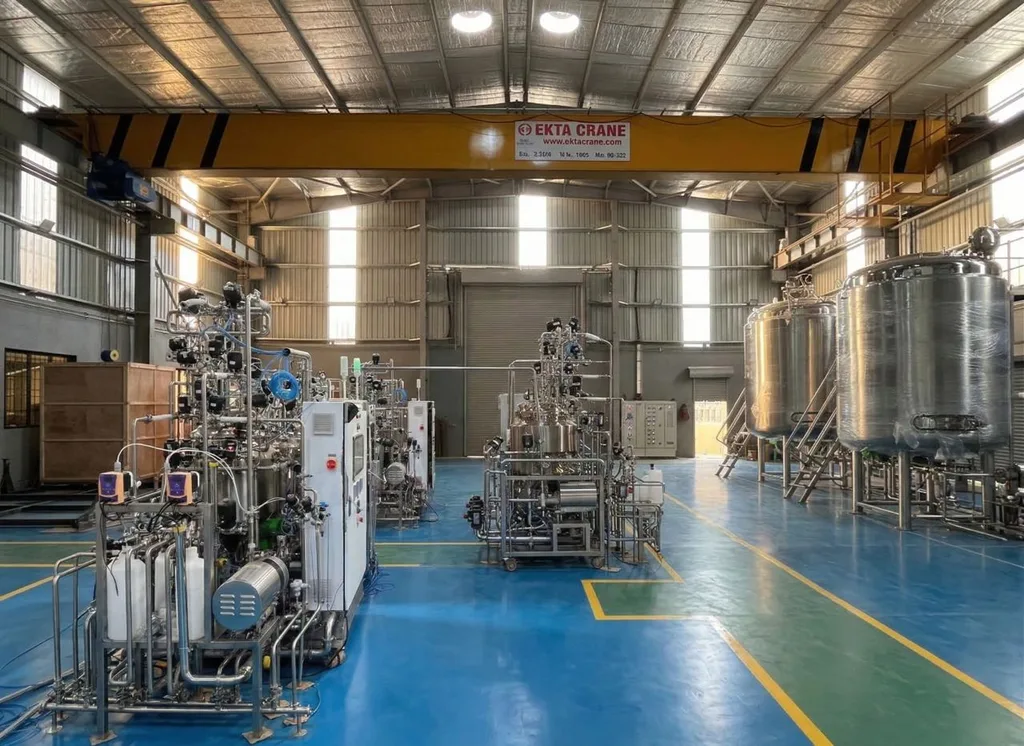
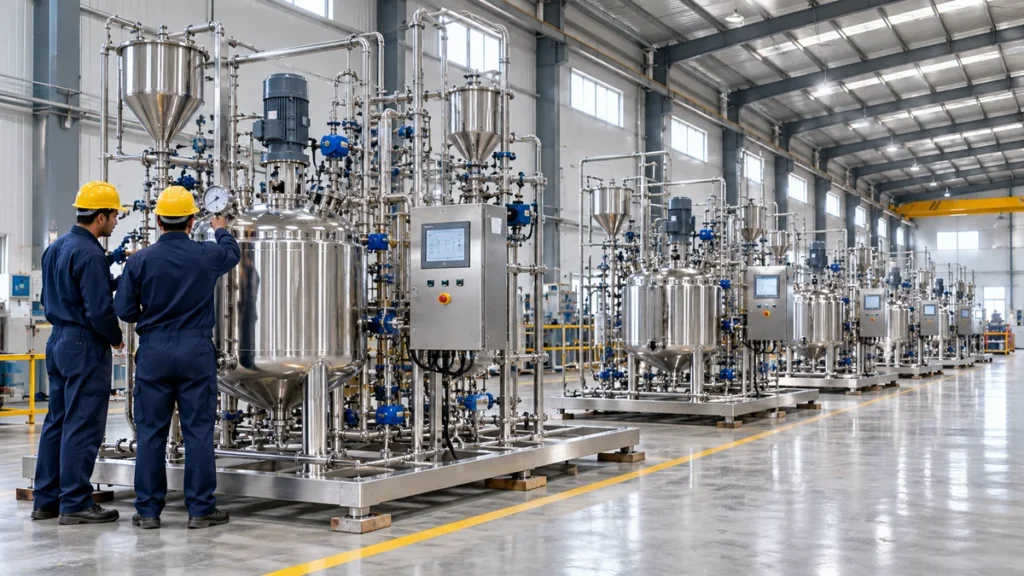
A skid-mounted system is built and tested as a complete unit on a frame, then shipped to site. Compared with building the same system in place, a skid moves most of the fabrication, piping and testing into a controlled factory environment, where it does not compete with civil works or other trades on site.
Esteril’s custom skid systems are compact and modular, GMP compliant and validated, and pre-tested for faster installation. They cover manufacturing vessels, sterile holding vessels, integrated piping and complex process skids. See our complex process skids and manufacturing vessel skids.
FAT before shipment
The most useful hours in a project are the ones spent finding problems before the equipment leaves the factory. Esteril’s FAT facility has more than 10,000 sq ft of dedicated testing space, a team of more than 15 specialised engineers, and live testing capability for process systems. Systems are tested against performance standards and client specifications before delivery, with complete FAT documentation.
For a sponsor-facing project, a documented FAT is also evidence you can share. Read more in our guide to FAT and SAT .
Oncology and potent compounds
Much of the demand shifting toward India is in complex and specialised products. Esteril’s complex skids include specialised configurations for potent compounds and oncology drugs such as doxorubicin and paclitaxel. If your new line will handle potent or oncology products, state the containment and handling requirements in the URS from the start. They affect the skid layout, the cleaning approach and the qualification scope.
Integration with clean utilities
A process skid only works as part of the plant around it. Esteril skids integrate with WFI, purified water, clean steam and compressed air systems. The interface points, pressures, flows and quality requirements for each utility should be fixed before detailed design begins. Late changes to utility interfaces are one of the most common causes of site rework.
Validation for USFDA, EMA and WHO GMP
Esteril systems are engineered to meet USFDA, EMA and WHO GMP requirements, with validation packages that cover DQ, FAT, IQ, OQ and PQ. For US-bound programmes, the automation matters as much as the equipment: Esteril’s automation is built to 21 CFR Part 11 and GAMP 5, with electronic batch records, an audit trail and a backup facility. .
Before you order: a checklist
| Decision | Settle before ordering |
| URS | Frozen and signed off by engineering, QA and production |
| Product scope | Products, strengths and any potent or oncology handling needs |
| Utilities | WFI, PW, clean steam and compressed air interface points and specs |
| Automation | Platform, Part 11 functions, EBR and integration with plant systems |
| FAT | Scope, test protocols and witness plan |
| Documentation | DQ, FAT, IQ, OQ, PQ scope and format |
| Handover | Programmes and editable drawings, training |
| Support | AMC scope, preventive service and technical support |
Frequently Asked Questions
Can process skids be tested before they reach our site?
Yes. Esteril tests systems at its dedicated FAT facility against performance standards and client specifications before delivery.
Which clean utilities can a skid integrate with?
WFI, purified water, clean steam and compressed air.
What support is available after handover?
Esteril offers an Annual Maintenance Contract covering essential maintenance, preventive service and priority technical support, and hands over final approved programmes and editable drawings after OQ.