Why Specialized Skids Matter in Modern Pharma
In pharmaceutical manufacturing, one size rarely fits all—especially when dealing with complex molecules. Whether it’s biologics, advanced APIs, or sensitive formulations, standard systems can’t always provide the precision or flexibility you need. This is where custom skids come in. These integrated, modular systems are engineered to meet the specific demands of your processes, especially when paired with high-performance Pharmaceutical Manufacturing Vessels.
As molecule complexity grows, the stakes get higher: contamination risks increase, yields become harder to optimize, and regulatory requirements become more demanding. Custom skids allow manufacturers to gain precise control, improve scalability, and maintain consistent quality—all within a compact and efficient footprint.
At Esteril, we specialize in crafting custom skid solutions tailored to the unique challenges of complex molecules. We integrate cutting-edge technologies with our deep understanding of Pharmaceutical Manufacturing Vessels to ensure seamless performance, every time.
What Are Pharmaceutical Manufacturing Vessels?
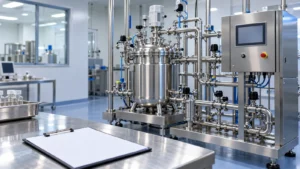
Pharmaceutical Manufacturing Vessels are specialized containers used in the production of pharmaceutical products. They handle a wide range of functions—from mixing and blending to fermentation and storage. These vessels must meet rigorous standards of cleanliness, material compatibility, and temperature/pressure control.
In pharmaceutical settings, vessels are designed for both batch and continuous operations. They are constructed from high-grade stainless steel or other compatible materials to prevent contamination. Pharmaceutical Manufacturing Vessels must also support clean-in-place (CIP) and sterilize-in-place (SIP) systems to meet regulatory and safety standards.
Because they play such a critical role, any equipment integrated with these vessels—including skids—must be designed to support consistent and safe processing.
Tackling Complexity: Why Standard Vessels Fall Short
The pharmaceutical industry is rapidly evolving. Therapies are becoming more targeted, and molecules are more fragile and variable. As a result, traditional vessel systems often can’t handle the specific needs of complex compounds.
For instance, some molecules require precise temperature gradients, gentle mixing, or ultra-pure environments. Standard Pharmaceutical Manufacturing Vessels, while reliable, aren’t always optimized for these unique demands. Therefore, companies need systems that can be tailored precisely to their formulation and process parameters.
Moreover, complex molecules often need multi-step processes involving several types of equipment. Without custom integration, there’s a risk of inefficiencies, longer changeovers, and product loss. Consequently, standard setups can slow down development timelines and introduce compliance risks.
To overcome this, manufacturers are increasingly turning to custom skids. These modular units are purpose-built and designed to work seamlessly with existing Pharmaceutical Manufacturing Vessels, enabling greater control and adaptability.
How Custom Skids Enhance Pharmaceutical Manufacturing Vessels
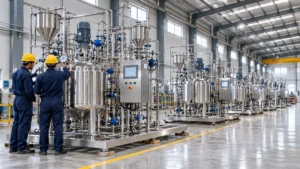
Custom skids are engineered to fit your specific production workflow. They consolidate pumps, valves, controls, heat exchangers, and sensors into a single, optimized platform. By aligning perfectly with your Pharmaceutical Manufacturing Vessels, they allow you to fine-tune every part of the process.
Furthermore, custom skids can be pre-validated and FAT-tested before installation, drastically reducing on-site commissioning time. In addition, these systems support a plug-and-play philosophy, minimizing downtime and human error.
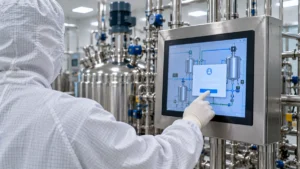
Let’s not forget automation. Custom skids often come equipped with advanced control systems, which enhance consistency and process visibility. When connected to Pharmaceutical Manufacturing Vessels, these skids allow real-time data tracking, recipe control, and electronic batch records.
The end result? Faster production cycles, better yields, and stronger compliance with cGMP standards.
Designing Skids Around Pharmaceutical Manufacturing Vessels
When designing custom skids for complex molecules, compatibility with Pharmaceutical Manufacturing Vessels is key. Here are the critical design considerations:
- Material Compatibility
Ensure skid components use materials suitable for API exposure and cleanroom environments. - Automation & Integration
Match control systems to the vessel’s automation layer for unified process management. - Scalability
Design skids to scale from pilot to commercial batch sizes without revalidation. - CIP/SIP Support
Enable seamless clean-in-place and sterilize-in-place processes to meet hygiene standards. - Footprint Optimization
Create a compact design that fits facility constraints while maximizing functionality. - Validation Documentation
Provide IQ/OQ documentation to speed up compliance audits.
These features ensure your skid works in harmony with Pharmaceutical Manufacturing Vessels, increasing process efficiency and lowering risk.
Real-World Examples with Pharmaceutical Manufacturing Vessels
Case Study 1: Biologic Formulation Line
A client needed a skid system for biologic formulation that required ultra-precise temperature control. The formulation involved a temperature-sensitive peptide, and the process window was tight.
We delivered a custom skid that paired with their existing Pharmaceutical Manufacturing Vessels, incorporating dual heat exchangers, backup pumps, and an integrated CIP module. Post-installation, yield improved by 22%, and batch failure rates dropped to zero.
Case Study 2: High-Potency Compound Handling
A contract manufacturer was struggling to safely handle high-potency APIs. Their vessel system couldn’t maintain isolation during transfer steps.
We built a contained transfer skid with glove ports, negative pressure zones, and HEPA filtration. It docked directly to their Pharmaceutical Manufacturing Vessels with no cross-contamination risk. The solution passed all HPAPI containment validation tests and enabled them to win new client contracts.
Advantages of Custom Skids for Pharmaceutical Manufacturing Vessels
Custom skid integration brings a wealth of benefits, especially when working with complex molecules:
- Improved Product Consistency
Greater control over conditions leads to uniform batch quality. - Faster Time-to-Market
Modular skids can be built and tested off-site, reducing launch delays. - Enhanced Compliance
Built-in documentation and traceability support audit readiness. - Scalability
Systems can grow with your pipeline without major reinvestment. - Reduced Risk
Minimizes human handling and contamination potential.
These advantages make custom skids a smart investment—particularly when aligned with your existing Pharmaceutical Manufacturing Vessels.
Guide to Choosing Custom Skids and Pharmaceutical Manufacturing Vessels
Here’s how to approach implementation:
- Assess Your Molecule’s Needs
Identify temperature, mixing, pressure, and contamination tolerances. - Audit Your Current Vessel System
Evaluate how your existing Pharmaceutical Manufacturing Vessels align with project requirements. - Engage a Custom Engineering Partner
Choose a team with skid and vessel integration expertise. - Design with Flexibility in Mind
Include spare ports, software upgradability, and extra capacity. - Validate Early
Use FAT and SAT testing to reduce deployment time. - Plan for the Future
Build modularity into the design for future upgrades.
Following this guide ensures that your skids not only support but elevate your Pharmaceutical Manufacturing Vessels for years to come.
FAQs About Custom Skids & Pharmaceutical Manufacturing Vessels
Q: Are custom skids necessary for every process?
A: Not always. But for complex molecules or multi-step processes, they’re often essential.
Q: How do skids integrate with existing Pharmaceutical Manufacturing Vessels?
A: They connect via sterile fittings and are automated for seamless operation.
Q: What’s the lead time for a custom skid?
A: Typically 10–16 weeks, depending on complexity and validation needs.
Q: Can one skid serve multiple vessels?
A: Yes, modular skids can be designed for flexible, multi-vessel integration.
Q: Do custom skids support regulatory compliance?
A: Absolutely. Most are designed to meet cGMP, FDA, and EU Annex 1 standards.
Conclusion
Custom skids represent the future of pharma manufacturing—especially for teams working with difficult-to-handle, high-value molecules. At Esteril, we understand how to tailor these systems for maximum efficiency, quality, and compliance.
Our solutions are engineered to work seamlessly with your Pharmaceutical Manufacturing Vessels, ensuring every batch performs as expected. If you’re ready to scale with confidence and reduce risks, we’re ready to help. Contact Esteril today to learn how we can support your next big breakthrough.