
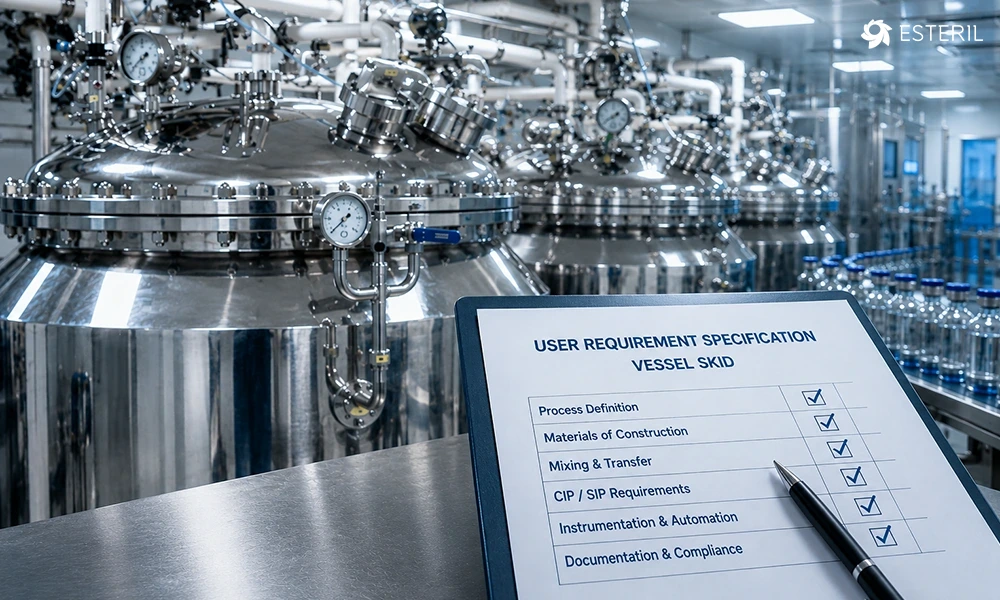
Most of the cost and schedule risk on a sterile vessel skid is decided before a single quotation arrives. It is decided in the User Requirement Specification.
A URS that states the process clearly gets comparable quotes, a clean design qualification and a factory acceptance test that actually proves something. A URS that lists only a volume and a material grade gets three quotes that cannot be compared, followed by change requests once fabrication has started.
This guide covers what a pharmaceutical URS for a manufacturing vessel skid should fix before it goes out, written from the questions that come up most often during design review.
1. Define the process before you define the equipment
The most common gap in a URS is that it describes a vessel instead of describing what the vessel has to do. A supplier cannot size a stirrer, a jacket or a transfer line from a volume figure alone.
State the following before anything else:
- Product type and category. SVP, LVP, ophthalmic, MDI or general injectable. Each carries different expectations for process design, containment, filtration, cleaning, sterilisation and surface finish.
- Batch size range, not a single number. Give the minimum working volume as well as the maximum. Minimum working volume drives stirrer position and vessel geometry more than maximum volume does.
- Product characteristics. Viscosity, solids content, whether the product is shear sensitive, whether it foams, and whether it is a potent compound.
- Process steps carried out in the vessel. Dissolution, mixing, heating, cooling, holding, pH adjustment, filtration or transfer.
- Number of batches per day and required turnaround time between batches. This determines whether cleaning and sterilisation cycle time becomes the constraint on your output.
| Point worth stating explicitly A 500 L vessel that has to run four batches a day with a full clean between them is a different machine to a 500 L vessel that runs one batch. If turnaround time is not in the URS, it will not be in the design. |
2. Materials of construction and surface finish
This section is usually present in a URS but rarely specific enough to be enforceable at FAT.
State the material grade for product contact parts and for non contact parts separately. Esteril builds product contact parts in SS 316L and non contact parts in SS 304, and this split should be written into the URS rather than assumed.
Surface finish needs a number and a method. Asking for an electropolished finish without a roughness value gives you no basis to reject anything. State the required Ra value for product contact surfaces and state that certificates for material and finish are to be supplied with the documentation package. Esteril electropolishes contact parts up to 0.3 µm Ra , and that figure is measurable and verifiable at FAT.
Also state your requirement for drainability. A vessel and its associated piping should be designed for full drainage around minimizing and controlling dead legs in accordance with the applicable hygienic design standard and this should be demonstrated during testing rather than claimed on a drawing.
3. Mixing, transfer and weighing accuracy
Mixing is where an underspecified URS costs the most, because the wrong agitator cannot be corrected cheaply after fabrication.
Specify whether you need a bottom driven or top driven stirrer, and whether a high shear mixer is required for the formulation. Bottom entry is common where low working volumes have to be mixed effectively. Top entry is often preferred where seal maintenance access matters more.
For transfer, state the accuracy you need on the batch. Where dosing accuracy is critical, specify load cells on the vessel and state the tolerance you will accept, along with the calibration certificate you expect. Weighing accuracy is a common source of dispute at site because it is left as a general expectation rather than a number.
4. Cleaning and sterilisation requirements
If the skid is CIP and SIP capable, the URS has to say what that means in your facility.
- Whether the CIP unit is tank based or tankless, and whether it is fixed or mobile.
- Whether acid and alkaline dosing is online and automatic, or manual.
- Which utilities you will supply and at what conditions. Purified water, WFI, clean steam, compressed air and chilled water, each with pressure, temperature and flow available at the skid boundary.
- The cleaning validation approach you expect. A riboflavin coverage test is the usual acceptance method for spray coverage and should be named in the URS so it appears in the FAT protocol.
- Whether cycle records must be printed, stored electronically, or both.
Utility conditions are the item most often left blank. If the supplier has to assume a steam pressure, the sterilisation cycle time you get at site may not be the one demonstrated in the factory.
5. Automation and data integrity
For any system that generates batch records, the automation section carries regulatory weight and should be written with your QA and validation leads in the room.
State the following:
- Control platform preference, if you have a site standard. Esteril works with Siemens, Schneider, Allen Bradley and Mitsubishi, so a site standard can normally be matched rather than worked around.
- Whether the skid is standalone with an HMI, or has to integrate with a plant SCADA or IPC layer.
- That the system is to comply with 21 CFR Part 11 for electronic records and signatures, and that software is to be developed and documented in line with GAMP 5.
- Audit trail, user access levels, electronic batch record requirements and backup and restore expectations.
- Which alarms and interlocks are safety critical, so they are tested individually at FAT rather than as part of a general run.
6. Documentation and handover
The documentation set is part of what you are buying. Write it into the URS as a deliverable list, not as a closing sentence.
A complete package for a sterile manufacturing vessel skid normally includes design qualification, the FAT protocol and report, installation, operational and performance qualification protocols, material and finish certificates, calibration certificates, and the operating and maintenance manuals.
Two items are worth naming specifically because they affect you for the life of the asset. The first is the editable drawing set. The second is the final approved control programme. Esteril hands over all final approved programmes and editable drawings after OQ completion, which means future modifications and requalification do not depend on the original supplier being available.
7. A URS checklist you can work from
The table below covers the sections that most often decide whether quotes are comparable.
| URS section | State this | Why it matters |
|---|---|---|
| Process definition | Product type, batch range, minimum working volume, process steps, batches per day | Drives vessel geometry, stirrer selection and cycle time |
| Capacity | Working volume range and design volume | Esteril builds from 1 L to 25,000 L, so the range needs to be stated rather than assumed |
| Materials | SS 316L contact, SS 304 non contact, with certificates | Makes material verifiable at FAT |
| Surface finish | Ra value for contact surfaces and finish method | Without a number there is no acceptance criterion |
| Mixing | Top or bottom drive, high shear requirement, shear sensitivity | Cannot be corrected after fabrication |
| Weighing | Load cell requirement and accepted tolerance | Prevents disputes at site over dosing accuracy |
| CIP and SIP | Tank or tankless, dosing method, utility conditions at skid boundary | Determines achievable cycle time in your plant |
| Cleaning validation | Riboflavin coverage test and acceptance criteria | Puts spray coverage into the FAT protocol |
| Automation | 21 CFR Part 11, GAMP 5, control platform, integration level, audit trail | Carries regulatory exposure if left vague |
| Documentation | DQ, FAT, IQ, OQ, PQ, certificates, manuals | Part of the scope, not an afterthought |
| Handover | Editable drawings and final approved programmes after OQ | Protects your ability to modify and requalify later |
| Site conditions | Door and access dimensions, floor loading, utility points, room classification | Decides whether the skid can be installed as built |
8. Gaps that cause change requests later
Four omissions account for most post order variation on skid projects.
- No minimum working volume. The vessel is sized for the maximum batch and cannot mix the smallest one properly.
- No utility conditions. The sterilisation cycle demonstrated in the factory cannot be repeated at site.
- No access dimensions. The skid is built as a single assembly and then has to be dismantled to get it into the room.
- No documentation list. The package delivered is complete by the supplier definition and incomplete by the QA definition.
All four are avoidable in the URS at no cost. All four are expensive once fabrication has started.
Frequently asked questions
How detailed should a URS be for a pharmaceutical vessel skid?
Detailed enough that two suppliers reading it would quote for the same machine. If a requirement cannot be tested or measured at FAT, it is a preference rather than a requirement, and it should be marked as such so suppliers know where they have design freedom.
Should the URS specify the make of instruments and valves?
Specify makes where your site has an approved vendor list, a spares holding or a maintenance standard to protect. Leave them open where you do not, because a fixed make with no operational reason behind it raises cost without improving the outcome.
Who should sign off the URS?
Typically engineering and projects, production, and QA or validation. Automation and data integrity requirements should be reviewed by QA before the URS is issued, because these are the hardest requirements to add afterwards.
Can a supplier help write the URS?
A supplier can help you structure it and can flag where a requirement is unclear or will drive unnecessary cost. The process requirements themselves have to come from your side, because they describe your product and your facility. Esteril reviews draft user requirement specifications with clients before quotation so that gaps are found at the specification stage rather than during design qualification.