Two vessels can look the same on a shop floor and behave very differently once they are in your plant. Most fabrication problems surface months later: rouge forming at a weld, a spray device that misses part of the shell, or a weld record that cannot be found when an auditor asks for it. By then the fix is expensive.
Nearly all of these risks can be checked before you place the order. This article covers what to look at, what to ask for, and what a good answer sounds like.
1. Materials and traceability
Product-contact parts of a biopharmaceutical vessel are usually 316L stainless steel. The grade on the drawing is only the start. Ask for the mill test certificates and check that each one can be traced by heat number to the parts it covers. Then ask how the fabricator keeps that link from the day material arrives to the day each piece is welded.
For tube ends that will be orbitally welded, ASME BPE limits sulphur content to between 0.005 and 0.017%. Sulphur affects how the weld pool behaves, so welding two parts with very different sulphur levels can pull the arc to one side and leave an uneven bead. Ask whether incoming material is checked against this range.
For more on material choices beyond 316L, see our article on material selection for aseptic holding tanks.
2. Welding
Product-contact tubing should be joined by orbital welding, which gives consistent penetration and a smooth internal bead. Ask the fabricator three things:
- Are the welding procedures and the welders qualified, and can you see the records?
- Is there a weld map that numbers every product-contact weld, with a weld log showing who made it, when, and how it was inspected?
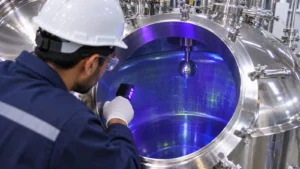
- How are internal weld beads inspected? Borescope inspection with recorded images lets you see the inside of a weld you can never reach after installation.
If the answer to any of these is vague, the weld records in your turnover package will be vague too.
3. Surface finish
The internal finish of a vessel affects how well it cleans and how easily product or biofilm can hold on. It is specified as a roughness average, Ra. For reference, ASME BPE’s electropolished finish grade SF4 sets a maximum of 0.38 µm Ra.
Ask the fabricator what Ra they work to on product-contact surfaces, how it is measured, at how many points, and whether readings are recorded for your vessel or only checked on samples. Ask too whether surfaces are electropolished after mechanical polishing, and how passivation is done and documented after fabrication.
4. Hygienic design on the drawing
Some problems are built in before any metal is cut. Review the general arrangement drawing with these points in mind:
- Drainability: the bottom dish, outlet and connected lines should slope so the vessel drains without pockets of standing liquid.
- Branches and nozzles: keep branches short. ASME BPE work has long promoted a branch length of no more than twice its diameter (L/D of 2 or less) so that cleaning and steam can reach the end.
- Spray device coverage: ask how the spray ball positions were chosen and whether a riboflavin coverage test will be run before dispatch.
- Instrument and sample points: check that each one can be cleaned and sterilised in place.
5. Testing before dispatch
A fabricator with its own QA/QC laboratory and test area can find and correct problems before the vessel leaves the shop. Ask which of these are done in-house: material verification, surface roughness checks, pressure and leak testing, spray coverage testing, and the full factory acceptance test with the automation running.
Ask whether your team can witness the FAT. Our article on FAT and SAT for pharmaceutical process skids lists what a complete FAT should include.
6. The documentation package
The turnover package is what your QA and validation teams work from, and what inspectors ask to see. Ask for a sample index before ordering. It should include:
- Material certificates traced by heat number
- Weld map, weld log and borescope records
- Surface finish and passivation records
- Pressure test reports
- P&IDs and as-built drawings
- FAT protocol and report, and IQ and OQ protocols
- Automation documents, and when the editable programs and drawings are handed over
A quick checklist for a shop visit
If you can visit the fabricator before ordering, these are worth seeing with your own eyes.
| What to look at | What a good answer looks like |
| Material store | Stainless steel kept apart from carbon steel, every piece marked with its heat number |
| Welding area | Orbital welding equipment in use, weld logs filled in at the bench, not afterwards |
| Polishing and finishing | Ra readings recorded per vessel |
| QA/QC laboratory | Material and finish checks done on site, with records you can ask to see |
| Test area | Space and utilities to run a full FAT with water and the control system |
| A recent turnover package | A clear index, with client names hidden, that matches the list above |
How Esteril fabricates vessels and skids
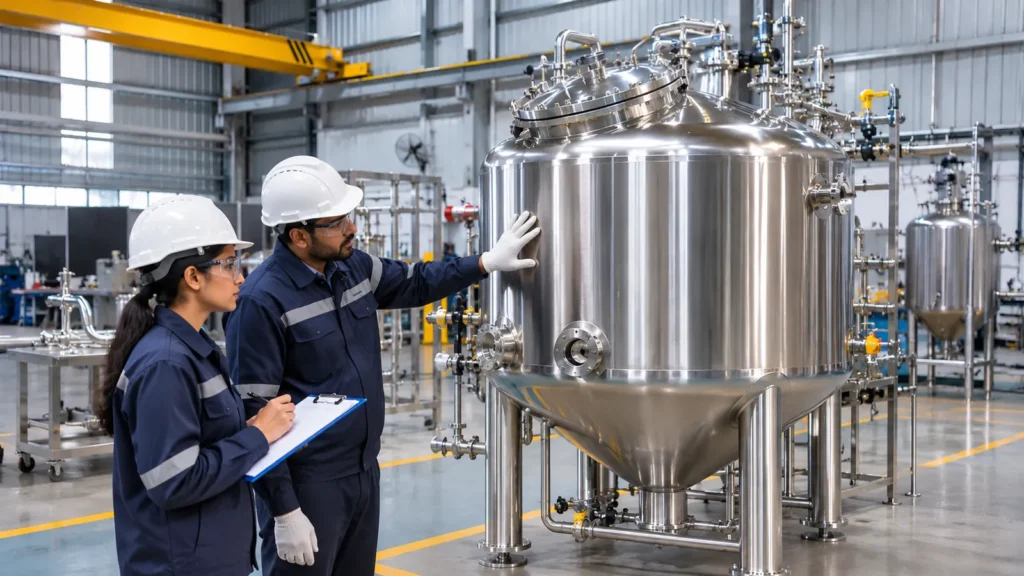
Esteril designs, fabricates and tests manufacturing vessels and skids and sterile holding vessels at its own 16,000 sq ft facility in Vasai. Product-contact welds are made with orbital welding, product-contact surfaces are finished to 0.3 µm Ra, and an on-site QA/QC laboratory handles material checks. A dedicated FAT area of more than 10,000 sq ft lets us run each system with water and its automation before it leaves the factory, with the client’s team present if they wish.
After OQ is complete, clients receive the final approved programs and editable drawings for their system.
If you are comparing fabricators for an upcoming project, you are welcome to visit the Vasai facility. Share your requirement and we will arrange a time.
Frequently asked questions
What surface finish is used for biopharmaceutical vessels?
Product-contact surfaces are usually mechanically polished and then electropolished. ASME BPE’s electropolished grade SF4 allows a maximum of 0.38 µm Ra. Esteril finishes product-contact surfaces to 0.3 µm Ra.
Why is orbital welding used for pharmaceutical tubing?
Orbital welding is automated, so each weld is made with the same settings. This gives consistent penetration and a smooth internal bead, which is easier to clean and to inspect with a borescope.
What documents should come with a biopharmaceutical vessel?
At minimum: traceable material certificates, the weld map and weld log, borescope records, surface finish and passivation records, pressure test reports, P&IDs, as-built drawings, and the FAT, IQ and OQ documents.
Can I visit Esteril’s fabrication facility before ordering?
Yes. Contact us to arrange a visit to our Vasai facility, including the fabrication floor, QA/QC laboratory and FAT area.