Automated clean in place systems take the manual labour out of cleaning process equipment, but a system that cleans reliably can still cost a plant hours of lost production if its cycles run longer than they need to. On a multi-product line, every extra minute in a CIP cycle is time the vessel is not making product.
This guide sets out where cycle time actually comes from, which design and control decisions extend it without adding any cleaning value, and how to shorten it while keeping cleaning validation intact. It is written for the people who specify, upgrade, and troubleshoot CIP on sterile and injectable lines.
Cycle time is a production number, not just an engineering one
CIP time is downtime. Water, WFI, cleaning chemicals, energy, and effluent load all scale with how long the cycle runs. On a single-product line cleaning happens rarely, so the cost is small. On a multi-product plant, cleaning dominates every changeover, and the cycle length sets how many batches a line can turn out in a shift.
That is the reason to treat cycle time as a target from the start. A validated cycle that is ten minutes shorter, repeated across every changeover in a year, returns real capacity and lowers the utility cost of each clean. The goal is never to clean less. It is to stop spending time that adds no cleaning value.
The four levers behind every CIP cycle
Every cleaning cycle balances four variables, and you can trade one against another. Reduce the time a phase needs by adjusting the other three, within safe and validated limits.
- Time. How long each phase runs. This is the variable most plants over-spend on, usually through cautious fixed timers.
- Action. The mechanical effect of flow. Turbulent flow scours the surface. A commonly used design rule is to hold roughly 1.5 m/s in the return line to keep flow turbulent and maintain full surface contact, though the right figure depends on line size and soil.
- Concentration. The strength of the caustic and acid solutions. Controlled dosing holds the right concentration without waste or overshoot.
- Temperature. Heat raises the solubility of most soils and speeds the chemical reactions in the wash steps. Running a wash below its target temperature is a quiet and common cause of long cycles.
When one lever is weak, operators compensate by adding time. Correcting the weak lever is what lets the time come down.
Where the time goes, phase by phase
A typical cycle runs through pre-rinse, an alkaline wash, an intermediate rinse, an acid wash where the soil calls for it, a final rinse, and an air blow to drain. Each phase has a point where time is commonly lost and a lever to recover it.
| CIP phase | What it does | Where time is lost | Lever to recover it |
|---|---|---|---|
| Pre-rinse | Flushes gross soil to drain with water | Fixed timer runs longer than the soil needs | End on turbidity or conductivity, not a clock |
| Alkaline (caustic) wash | Breaks down organic and protein soil | Running below target temperature slows the reaction | Correct temperature with verified return-line velocity |
| Intermediate rinse | Removes caustic before the acid step | Over-rinsing as a safety margin | Conductivity endpoint to confirm caustic is cleared |
| Acid wash | Removes mineral and inorganic scale | Run on every cycle even when the soil does not need it | Recipe logic that applies it only where the product profile requires |
| Final rinse | Brings residues down to release spec | One long fixed rinse for every product | Conductivity or TOC endpoint; recover rinse water for the next pre-rinse |
| Air blow and drain | Clears the line and vessel | Trapped liquid from poor drainage extends the blow | Drainable routing and slope so lines empty cleanly |
Design choices that quietly add minutes
Some of the longest cycles are not a chemistry problem at all. They are built into the equipment.
- Dead legs and stagnant zones. Where liquid pools, it takes longer to rinse out and gives soil and biofilm a place to settle. Keeping branch runs short relative to their diameter reduces this and shortens rinsing.
- Poor drainage. Lines and vessels that do not empty fully hold rinse water, which extends the air blow and risks carrying residue into the next step. Sloped, drainable routing clears faster.
- An undersized return pump. If the return cannot keep pace with the supply, the system never reaches its target velocity, so cleaning falls back on time to make up for lost mechanical action.
- Over-conservative fixed timers. The single most common reason a cycle is longer than it needs to be. A timer set for the worst case runs at the worst case every time, regardless of the actual soil.
Where automation actually shortens the cycle
Automation earns its place when it replaces a fixed assumption with a measured condition.
- Endpoint control instead of fixed timers. Conductivity and flow instruments end a phase when the measured condition is met rather than when a timer expires. This is usually the largest single saving available.
- Controlled dosing. Inline conductivity control holds the acid and alkaline concentration at target without overshoot, so the wash works at full strength without waste.
- Recipe management. Different products and soils get a right-sized cycle instead of one worst-case recipe applied to everything on the line.
- Data and audit trails. A control system that records every parameter of every cycle makes a shorter cycle defensible in validation and audit, not just faster on the floor.
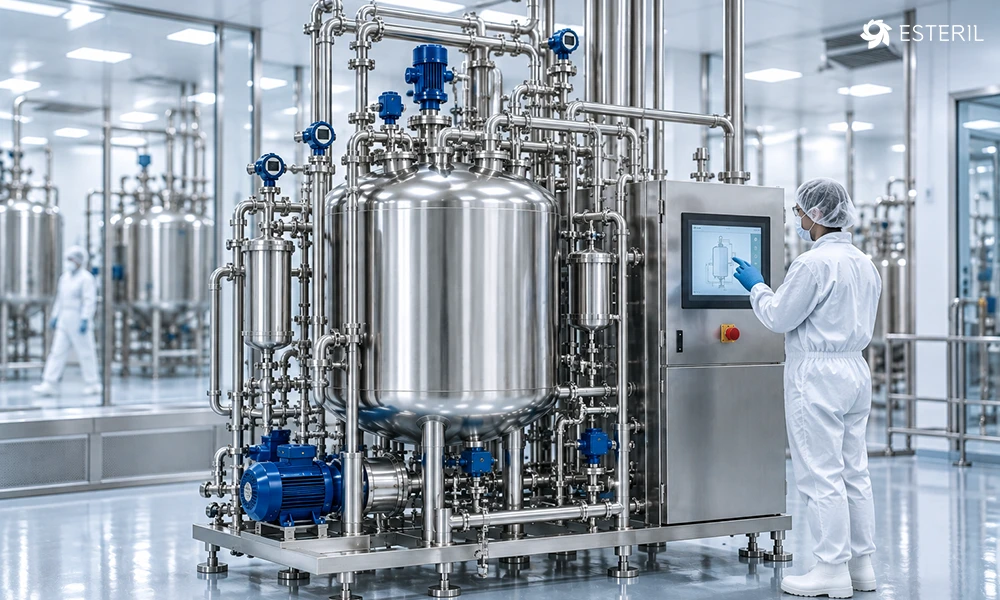
This is the ground Esteril builds on. Its In-Situ CIP/SIP systems are custom, modular, skidded units supplied in mobile and fixed configurations, with supply and return pumps for recirculation, online acid and alkaline dosing, and PLC control running time and temperature programs. Automation is delivered with IPC and SCADA built to 21 CFR Part 11, so every cycle is loggedand traceable. Contact parts are SS 316L, mirror polished and electropolished, and cleaning is validated with a riboflavin coverage test alongside DQ, IQ, OQ, and PQ documentation.
The cheapest time to optimise a cycle is before the skid is built
Retrofitting endpoint control, resizing a return pump, or re-routing pipework for better drainage after installation is expensive and disruptive, and often means re-qualifying the system. Specifying the right instrumentation, pump sizing, and drainable routing at the design stage bakes the savings in from the first cycle.
If you are writing a user requirement specification for a new CIP/SIP skid, put cycle-time targets and endpoint control in it explicitly. It is far easier to design a short validated cycle than to shorten a long one that is already qualified.
Frequently Asked Questions
Can you shorten a CIP cycle without re-validating it?
Any change to a validated cleaning cycle needs a documented assessment and usually re-qualification. The value of endpoint control is that it lets you design a shorter cycle that still meets the cleaning limits, then qualify it once, rather than trimming a live cycle by guesswork.
Is a mobile CIP skid slower than a fixed one?
Not by itself. Cycle time is driven by flow, temperature, chemistry, and control, not by whether the skid is mobile or fixed. Mobile units suit multi-product plants running smaller and more varied batches, where one skid serves several vessels.
What return-line velocity should a CIP loop target?
A widely used design rule is around 1.5 m/s in the return line to keep flow turbulent and maintain full surface contact. The right figure for a given system depends on line diameter and the soil being cleaned, and should be confirmed in design.