Most cleaning and sterilization failures are not chemistry failures. They are geometry failures. A CIP/SIP skid can dose the right chemicals at the right temperature and still leave surfaces that never get properly cleaned or sterilized, because the cleaning fluid and the steam cannot physically reach them. The usual culprit is a dead leg, and the usual consequence, over time, is biofilm.
Good CIP/SIP skid design is largely about designing out the conditions those problems need. It is worth being clear at the start that no real system has no dead legs at all. Instrument ports, valves, and branches exist. The engineering goal is to minimise and control them within accepted limits, so that flow and steam reach every surface. This guide sets out how that is done, and is written for the engineers specifying and designing these systems.
What a dead leg is, and why it defeats cleaning and sterilization
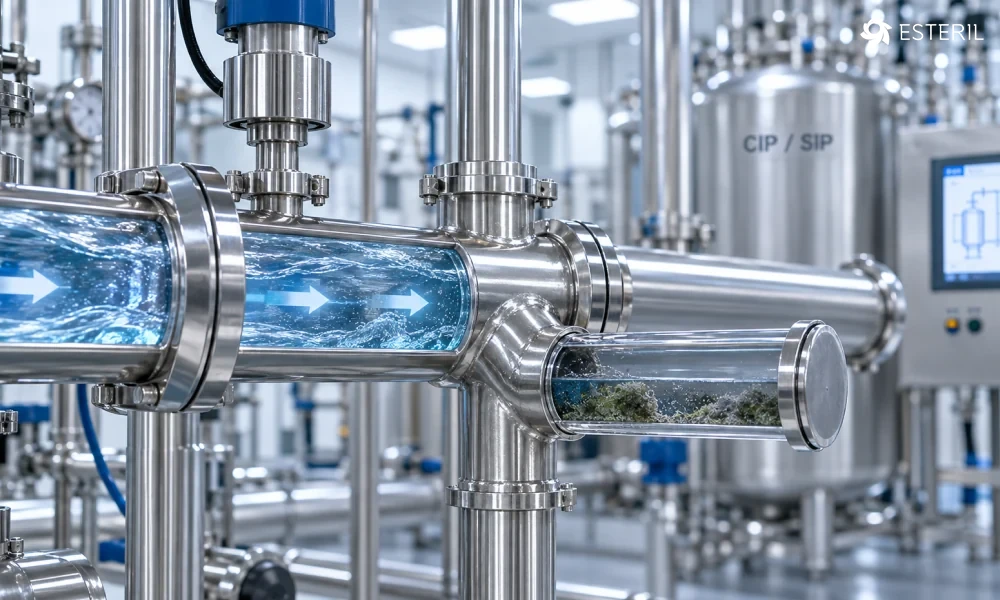
A dead leg is a section of pipe, a branch, a tee, an instrument port, or a pocket beyond a valve, where flow does not reach or where fluid can sit undisturbed. It is a small feature with an outsized effect.
In CIP, the cleaning solution circulates through the main flow path but may not fully penetrate a dead leg, so soil and microorganisms survive the cycle in that pocket. In SIP, steam has to reach every surface at sterilization temperature and displace the air in front of it. In a dead leg, trapped air or pooled condensate can stop steam reaching temperature, leaving a cold spot that is never sterilized. Either way, the dead leg becomes the weak point that the rest of a well-run cycle cannot compensate for.
How biofilms form, and why they are hard to remove
Microorganisms attach to a surface, multiply, and build a protective matrix around themselves. Once a biofilm is established, it resists cleaning chemicals, and to a degree sterilization, far more than free-floating cells do. A stagnant, poorly drained zone is exactly the stable, undisturbed surface a biofilm needs to establish.
This is why the reliable fix is in the geometry, not in stronger chemicals. You cannot dependably clean your way out of a biofilm sitting in a dead leg. You design the dead leg out, so the organisms never get the conditions to settle in the first place. Prevention through design is more dependable than remediation through chemistry.
The L/D ratio rule
The length-to-diameter, or L/D, ratio measures how long a branch is relative to its bore. The longer a branch is relative to its diameter, the harder it is for flow and steam to sweep through and reach the end of it.
The widely used design guidance limits dead-leg length to an L/D of 2 or less, measured from the wall of the main line to the obstruction. Keeping branches within that limit reduces the stagnant volume that flow cannot clear. In practice this means keeping instrument ports and valve connections as short as possible and as close to the main line as possible, removing branches that are not needed, and positioning valves so there is minimal pocket beyond them.
Drainability and steam access in SIP loops
A SIP loop has two extra demands beyond cleaning. It has to drain condensate, and it has to let steam displace air. As steam gives up heat it forms condensate, and if that condensate pools it creates cold spots and a place for microorganisms to sit. Low-point drains and sloped routing let condensate clear so steam holds temperature through the loop.
Air is the other problem. Steam cannot sterilize a surface where air is trapped in front of it, so the loop is designed to vent and displace air, with no high pockets that hold it. Tees and branches are oriented to drain rather than to trap. These are design decisions, made on the drawing, not adjustments made later on the floor.
The design levers that control dead legs
These are the levers a CIP/SIP skid design uses to keep every surface reachable by cleaning fluid and steam.
| Design lever | What it does | Effect on cleaning and sterilization |
|---|---|---|
| Short branches (low L/D) | Keeps branch length within accepted limits | Flow and steam reach the branch, so less stagnation |
| Valve selection and placement | Zero-static or diaphragm valves close to the main line | Minimal pocket beyond the valve where fluid can sit |
| Sloped, drainable routing | Lines and vessels empty toward low-point drains | Condensate and rinse water clear, so fewer cold spots |
| Removing unnecessary branches | Fewer ports and tees overall | Fewer places for stagnation and biofilm to start |
| Surface finish | Electropolished contact surfaces | Fewer microscopic sites for microbial attachment |
| Air venting in SIP | Air is displaced so steam reaches every surface | Sterilization temperature is achieved throughout |
Design is cheaper than remediation
A dead leg found after installation is expensive to fix. It can mean re-piping, re-validation, and lost production, and a biofilm problem discovered in service can mean investigations and rejected batches. None of that is cheap, and none of it is quick.
Getting the geometry right at the design stage, within accepted L/D limits and with drainable, ventable routing, is far cheaper than finding the failure in a validation run or an audit. Esteril designs and builds In-Situ CIP/SIP systems with interconnected piping, valves, and instrumentation on a sanitary design to cGMP, with electropolished 316L contact surfaces, and validates cleaning with a riboflavin coverage test alongside DQ, IQ, OQ, and PQ documentation. The routing is designed to minimise dead legs and to drain, rather than left to chance and corrected afterwards.
Frequently Asked Questions
What is an acceptable dead-leg length?
Dead-leg length is commonly limited to an L/D ratio of 2 or less, measured from the main line to the obstruction. The aim is to keep branches short enough that flow and steam can reach them and clear them.
Can you eliminate dead legs completely?
In practice, some branches, ports, and valves are unavoidable, so the realistic engineering goal is to minimise and control dead legs within accepted limits, not to claim none exist. Good design keeps them short, drainable, and reachable by cleaning fluid and steam.
How does design prevent biofilm?
A biofilm needs a stable, undisturbed, poorly cleaned surface to establish. Removing stagnant zones through short branches, drainable routing, and a smooth surface finish denies it those conditions, which is far more reliable than trying to clean an established biofilm out later.