Choosing between a mobile CIP/SIP skid and a fixed system is one of the earliest decisions in a cleaning project, and it shapes capital cost, floor space, and how flexibly the plant can run for years afterwards. Neither is better in the abstract. They suit different production patterns, and picking the wrong one means either paying for capacity you do not use or building in a bottleneck you cannot easily remove.
This guide compares the two on the factors that actually decide it, and sets out a simple way to reach the right answer for your line. It is written for the engineers, plant heads, and procurement teams specifying cleaning for a new or expanding facility.
The real question is your production pattern, not the skid
The decision follows from how the plant runs, not from a preference for one design. How many products the line handles, how large and how frequent the batches are, how many vessels need cleaning, how often, and how much permanent floor space and utility capacity you have all point toward one answer or the other.
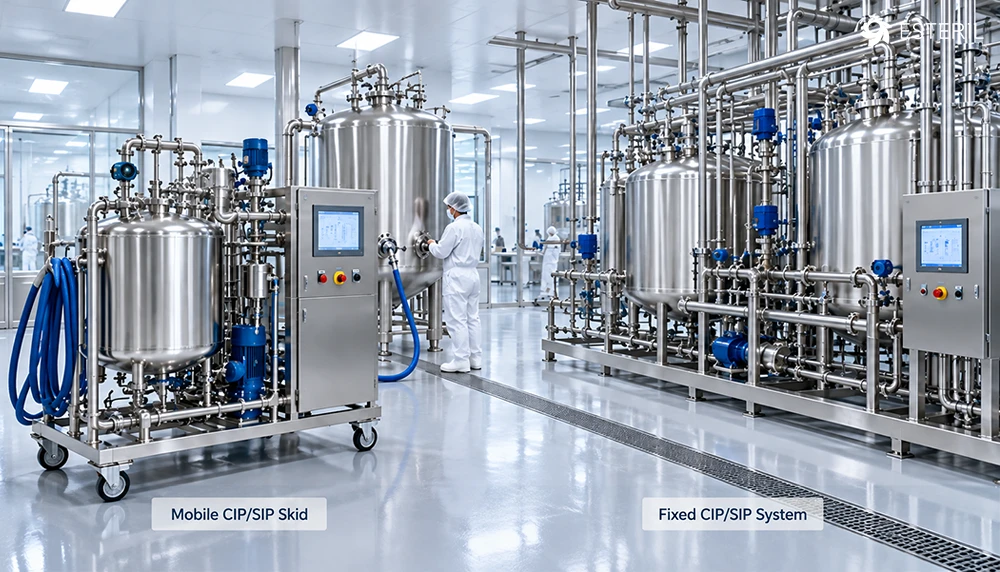
A mobile skid is a self-contained unit wheeled between vessels and areas, cleaning one point at a time. A fixed system is permanently installed and piped to dedicated cleaning points, usually serving a large, steady line. Everything else follows from that difference.
When a mobile CIP/SIP skid fits
A mobile skid earns its place where flexibility matters more than raw throughput.
- Multi-product facilities with smaller, varied batches, where the cleaning demand shifts with the product mix.
- Several vessels that do not all need cleaning at the same time, so one skid can serve many points and lower the capital cost per point.
- Plants that are phasing in capacity, are short on permanent floor space, or want to keep future options open.
- R&D, pilot, and contract manufacturing lines where the product mix changes regularly.
The trade-offs are manual connection and disconnection at each point, the scheduling needed to keep the skid where it is required, and throughput limited by one unit serving several vessels.
When a fixed CIP/SIP system fits
A fixed system suits scale and repetition.
- Large, high-volume lines running a single product or a small set of products.
- Many cleaning points that are cleaned frequently, where a shared mobile unit would become a bottleneck.
- Facilities where permanent piping, dedicated utilities, and full automation are justified by the volume they support.
The trade-offs are higher upfront cost, a permanent commitment of floor space and utility runs, less flexibility if the product mix changes, and more pipework to design, clean, and validate.
Mobile vs fixed CIP/SIP skid, side by side
| Factor | Mobile CIP/SIP skid | Fixed CIP/SIP system |
|---|---|---|
| Best suited to | Multi-product plants with smaller, varied batches | High-volume single-product or few-product lines |
| Vessels served | Several, one at a time | Dedicated points, often many at once |
| Capital cost | Lower per cleaning point when one skid is shared | Higher, justified by throughput |
| Floor space | Compact and movable, stored when idle | Permanent footprint and utility runs |
| Flexibility | High; redeploys as the product mix changes | Lower; built around a set line |
| Throughput | Limited by one unit serving many points | Higher; parallel cleaning is possible |
| Connection | Manual connect and disconnect at each point | Permanently piped to fixed points |
| Validation | Each connection point is validated | Each fixed loop is validated once |
What stays the same either way
Whichever configuration you choose, the cleaning still has to be validated and documented, and the engineering underneath is the same: correct flow velocity, controlled temperature and chemistry, drainable routing, and a recorded, repeatable cycle. The choice of mobile or fixed changes how the system is deployed, not the standard it has to meet.
Esteril builds both. Its In-Situ CIP/SIP systems are supplied as custom, modular, skidded units in mobile and fixed configurations, with supply and return pumps for recirculation, online acid and alkaline dosing, and PLC control running time and temperature programs, with IPC and SCADA to 21 CFR Part 11. Contact parts are SS 316L, mirror polished and electropolished, and cleaning is validated with a riboflavin coverage test alongside DQ, IQ, OQ, and PQ documentation. The configuration is a fit-to-production decision, not a trade against engineering standard.
A simple way to decide
Use this as a starting point, then pressure-test it against your own numbers.
- Many products, varied and smaller batches, a changing mix: lean mobile.
- One or a few high-volume products with many points cleaned often: lean fixed.
- Phasing capacity, limited floor space, or an uncertain future mix: mobile keeps options open.
- Frequent simultaneous cleaning across a large line: fixed avoids the bottleneck.
For many plants the honest answer is a mix: a fixed system on the core high-volume line and a mobile skid for ancillary or multi-product areas. The point is to match the cleaning to how the plant actually produces, not to standardise on one design for its own sake.
Frequently asked questions
Is a mobile CIP skid less thorough than a fixed one?
No. Cleaning quality is set by flow, temperature, chemistry, control, and drainage, not by whether the skid moves. A well-designed mobile skid cleans to the same validated standard as a fixed system.
Can one mobile skid clean every vessel in a plant?
It can serve several vessels, but not all at once. When many points need cleaning at the same time, a shared mobile unit becomes a scheduling bottleneck, and a fixed system or additional units make more sense.
Which is cheaper?
Mobile is usually lower in capital cost per cleaning point when one unit is shared across several vessels. Fixed costs more upfront but suits high-throughput lines where a shared unit cannot keep pace. The cheaper option depends entirely on the production pattern, which is why the decision starts there.