In biologics manufacturing, every vessel, transfer line and filter must be sterile before the product touches it. A non-sterile line can cost a whole batch, and with a biologic that batch is often worth more than the equipment that lost it.
A steam-in-place (SIP) skid does four jobs: it delivers clean steam, pushes out the air, drains the condensate, and holds and records the temperature long enough to prove sterility. Whether that works first time during validation depends mostly on what was written into the specification. This article covers the points to settle before a supplier starts the design.
1. Draw the SIP boundaries first
List every item each SIP cycle must sterilise: vessels, transfer lines, filter housings, valves, sample points and instrument connections. Then mark on the P&ID exactly where each SIP circuit starts and stops, and which valve isolates it from the non-sterile side.
Biologics plants have many transfer panels and short connections between buffer, media and formulation vessels. If the boundaries are vague, some branch will end up neither in the CIP/SIP circuit nor clearly outside it, and that is where validation runs fail.
2. Steam supply and steam quality
SIP for product-contact equipment uses clean steam, and EU GMP expects the condensate of steam used for direct sterilisation to meet the WFI monograph. For the physical quality of the steam, many sites use the EN 285 tests as a reference:
| Test | EN 285 limit |
| Dryness value | 0.95 or more |
| Non-condensable gases | No more than 3.5 ml of gas per 100 ml of condensate |
| Superheat | No more than 25 °C when expanded to atmospheric pressure |
State in your URS where the clean steam comes from, the supply pressure at the skid, and where the steam quality test points will be. Our article on clean utilities for process skids covers the steam interface in more detail.
3. Air removal
Air is a poor conductor of heat. A pocket of air at the top of a vessel or in a branch can stay below sterilising temperature while the rest of the system looks fine on the screen. Specify vent points at each high point of the circuit and a purge phase in the sequence before the temperature hold starts. Keep branches short so steam can reach the ends. Our article on controlling dead legs in CIP/SIP skid design explains why.
4. Condensate removal
Steam turns to condensate as it heats the steel. If condensate collects at a low point, that spot cools, and the cycle either alarms or fails validation. Each low point needs a drain with a sanitary steam trap, and lines must slope towards the drains.
Traps are a common cause of temperature alarms during the hold. A trap that holds back too much condensate cools the line in front of it. Ask the supplier which trap type they use, how it is sized for the heat-up load and the much smaller hold load, and where the temperature sensor sits relative to the trap.
5. Temperature and hold time
The hold starts once the coldest point in the circuit reaches the set temperature, commonly 121 °C or above. Many sites hold for 20 to 30 minutes, but your hold time must come from your own validation, not from a supplier’s standard cycle.
Specify permanent temperature sensors at the points found to be slowest to heat, usually the drains, and an alarm that stops the hold count if any sensor drops below the set point.
6. Filters
Vent filters on vessels and process filters on transfer lines are usually sterilised with the system. Steam them in the direction and within the differential pressure limits set by the filter manufacturer, or the membrane can be damaged.
A filter is wet after SIP, which affects integrity testing. Plan how the filter will be dried with sterile air or nitrogen, and where the integrity test connections will be, before the skid layout is fixed.
7. Cool-down without losing sterility
When the steam is shut off and condenses, pressure inside a closed vessel falls quickly. If nothing replaces it, the vessel can be pulled under vacuum and draw non-sterile air in through a seal or a connection.
Specify how the system is kept at positive pressure during cool-down, usually with sterile filtered air or nitrogen, and whether the vessel is designed for full vacuum. Also state how long the system may stay sterile before use, since that hold time also needs to be validated.
8. Valves and seals
Repeated steam cycles age elastomers. Diaphragm valves are common on biologics skids because the product side has no stem seal. Ask what diaphragm and gasket materials are proposed for your steam temperature and cycle count, and what replacement interval the supplier recommends.
9. Automation and records
The control system runs the valve sequence, monitors every sensor and produces the cycle report your QA team will review. Specify the report contents, the alarms that stop a cycle, and how audit trails, user access and electronic signatures meet 21 CFR Part 11. Software validation should follow GAMP 5. See our pharmaceutical automation systems page for the platforms we work with.
10. Validation
SIP validation usually combines temperature mapping with biological indicators, placed at the worst-case points such as drains, filter housings and the far ends of branches. Ask the supplier how much of this can be dry-run or simulated at FAT, and what will only be proven at site with live steam. EU GMP Annex 1 expects the sterilisation process to be validated and monitored. Our article on EU GMP Annex 1 equipment requirements covers what it asks of equipment.
What to write in your URS: a summary
| Point | What to state |
| SIP boundaries | Every vessel, line, filter and sample point in each circuit, marked on the P&ID |
| Steam | Source, pressure at the skid, quality test points |
| Air removal | Vent points at high points, purge step before the hold |
| Condensate | Drain and trap at every low point, line slopes |
| Temperature | Set point, sensor locations, alarm action |
| Hold time | To be set by validation |
| Filters | Steam direction, differential pressure limit, drying and integrity test points |
| Cool-down | Sterile air or nitrogen overpressure, vacuum rating, post-SIP hold time |
| Valves and seals | Valve type, elastomer materials, replacement interval |
| Automation | Cycle report, alarms, Part 11 controls, GAMP 5 approach |
| Testing | What is shown at FAT and what is proven at SAT |
How Esteril builds SIP for biopharma
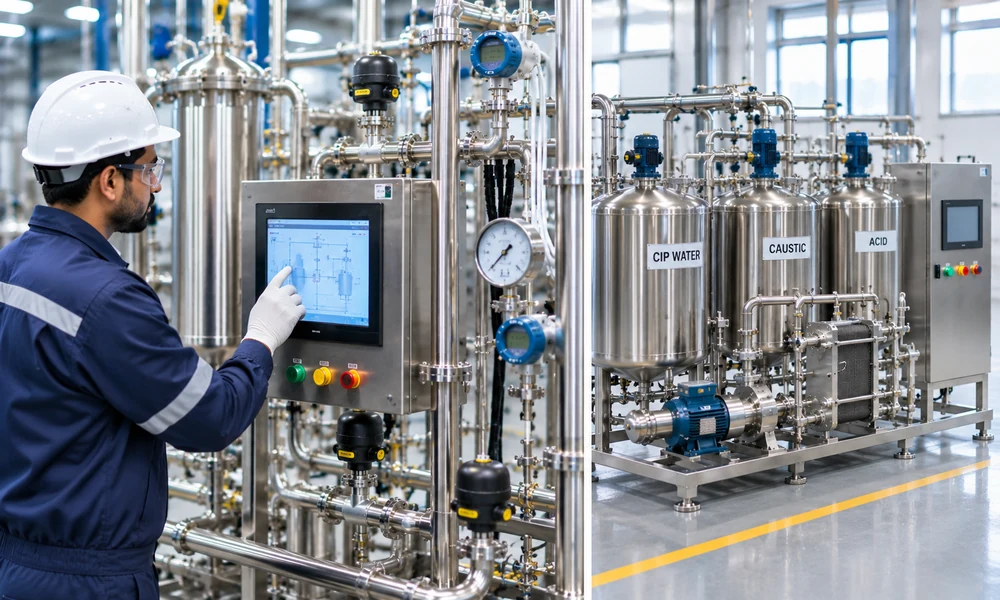
Esteril designs in-situ CIP/SIP systems that are built into manufacturing and holding vessels or supplied as separate skids, and complex process skids that connect to clean steam, WFI, purified water and compressed air. Automation is built on Siemens, Schneider, Allen Bradley or Mitsubishi platforms, with 21 CFR Part 11 controls. Each system is run through FAT at our Vasai facility before dispatch.
If you are writing the specification for a biologics SIP skid, send us your draft URS or P&ID and our engineers will review the SIP circuits with you.
Frequently asked questions
What temperature is used for SIP in biologics plants?
Commonly 121 °C or above at the coldest point of the circuit. The hold time, often 20 to 30 minutes, is set and proven during validation.
Why does air removal matter in SIP?
Air insulates. A trapped pocket of air can stay below sterilising temperature even when the rest of the system is at set point, so vents and a purge step are needed before the hold starts.
Can CIP and SIP run from the same skid?
Yes. In-situ CIP/SIP systems handle both cleaning and steam sterilisation of the same vessels and lines, using one control system and one set of records.
How is a SIP cycle validated?
By temperature mapping and biological indicators at the worst-case locations, such as drains, filter housings and branch ends, over repeated cycles.