
Most cost and schedule problems on a pharmaceutical process skid are decided before the purchase order is raised. A URS written after the design was frozen. A quotation that left out documentation. A FAT scope nobody agreed. A utility that was not ready on the day of SAT. Each of these can be avoided, and each is cheaper to fix early.
This checklist follows a skid from first requirement to handover in seven stages. For each stage it says what to settle, what to ask the supplier, and which of our detailed guides covers the topic. It is written for project engineers, procurement heads and validation leads at pharmaceutical and biopharmaceutical manufacturers.
Why procure in stages
EU GMP Annex 15 asks that qualification activities consider every stage from the user requirements specification through to the end of use of the equipment (section 3.1). The same logic works for buying. Each stage produces a document or a decision that the next stage depends on. When a gate is skipped, the gap usually returns later as a deviation, a change request or a delay at SAT.
Stage 1, Define the requirements (URS)
The URS is the reference point for the whole project. Annex 15 (3.2) says the essential elements of quality need to be built in at this stage and that the URS should stay a point of reference through the validation life cycle. Before inviting quotations, settle the following.
- Product and process: the process steps the skid performs (mixing, holding, transfer, dosing), the batch size range, and the operating range of temperature and pressure.
- Vessel and skid configuration: number of vessels, agitation type, weighing, jacketing, outlets and transfer routes.
- Cleaning and sterilisation: the CIP/SIP method, whether it is integrated or a separate unit, and the cycle expectations.
- Materials and finish: product contact materials, surface finish and weld documentation expectations.
- Automation and data: PLC and SCADA platform, 21 CFR Part 11 and Annex 11 expectations, audit trail, electronic batch records where needed.
- Utilities at the point of installation: WFI, purified water, clean steam, compressed air, electrical supply and drains.
- Documentation and qualification: the protocols and records you expect (DQ, FAT, IQ, OQ, PQ) and their format.
- Markets and regulators the product will be filed for.
Our guide on how to write a URS for a sterile manufacturing vessel skid goes through each section. For vessel-specific points, see the sterile manufacturing vessels specification guide.
Stage 2, Shortlist suppliers
Base the shortlist on what the supplier does in-house and what they can show you, not on the length of the brochure. Useful questions:
- Which activities are in-house? Fabrication, welding, electropolishing, panel build and FAT. Esteril, for example, fabricates in its own facility using orbital welding, has an on-site QA/QC laboratory for material validation, and tests systems at its own FAT facility.
- Which automation platforms are supported, and who owns the programme after OQ? Esteril works with Siemens, Schneider, Allen Bradley and Mitsubishi platforms. See how to choose a pharmaceutical plant automation vendor and the pharmaceutical automation systems page.
- Can they show documentation from a comparable project? A sample FAT protocol or IQ/OQ format tells you more than a capability statement.
- What happens after handover? Training, spares, annual maintenance contract and on-site engineer support.
- Which regulatory markets has their documentation been used for?
Stage 3, Compare quotations on scope, not price
Two quotations for the same skid can differ widely because they cover different things. Put the scope lines side by side before comparing totals.
| Scope line | What to confirm in writing |
| Design documents | P&IDs, general arrangement drawings and a written equipment design description, which Annex 1 (5.1) expects to be part of the initial qualification package and kept up to date |
| Materials and weld records | Material certificates, weld documentation, surface finish records |
| Qualification protocols | DQ, FAT, IQ, OQ and PQ protocols: who writes them, who executes them, who approves them |
| FAT | Included or extra, duration, test items, who attends, how deviations are closed |
| Installation and commissioning | Included or extra, SAT support, site engineer days |
| Automation | Software ownership, handover of final approved programmes and editable drawings (Esteril provides these after OQ completion), audit trail and Part 11 functions |
| Spares and consumables | Commissioning spares and the recommended spares list |
| Training and support | Operator and maintenance training, AMC terms |
| Exclusions | Utilities, civil works, hook-ups, analytical methods and validation services that stay with the buyer |
The automation vendor guide and the guide on Annex 11 and 21 CFR Part 11 for process skid automation cover what to ask on the software side.

Stage 4, Design review and design qualification
Design qualification demonstrates and documents that the design complies with GMP and checks the URS requirements (Annex 15, 3.3). In practice this is the review of P&IDs, layout and materials before fabrication starts. Check the following.
- Piping geometry and drainability. Dead legs and low points are design decisions, not commissioning fixes. See CIP/SIP skid design: controlling dead legs and biofilm risk.
- Materials of construction for every product contact component, including seals and instruments. See material selection for aseptic holding tanks.
- Hygienic construction against the standard named in the URS, for example ASME BPE. See Decoding ASME BPE standards.
- Vessel geometry and mixing against the product. See why tulip-shaped vessels matter.
- CIP/SIP arrangement and whether a mobile or fixed unit suits the plant. See mobile vs fixed CIP/SIP skids and how to specify a CIP/SIP skid.
- Hold times and the sterile boundary where the skid holds product. See sterile holding vessels: how to specify them.
- Utility connection points and quality. See clean utilities for process skids.
Stage 5, Factory acceptance test (FAT)
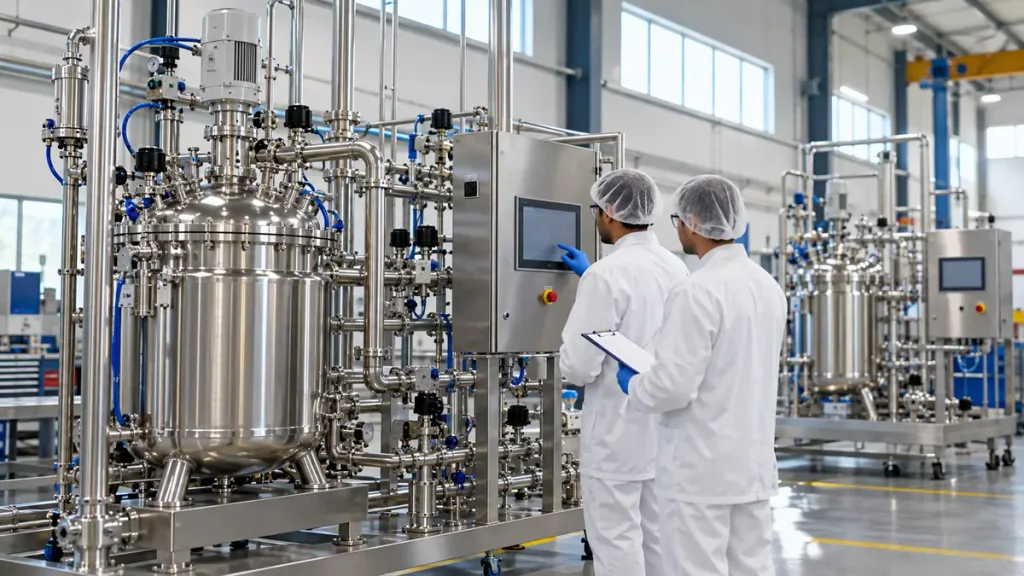
FAT is the last point at which a problem is cheap to fix. Annex 15 allows equipment to be checked against the URS at the vendor site before delivery (3.5). It also allows some tests at FAT to be accepted without repeating them on site, if it can be shown that the functionality is not affected by transport and installation (3.6). That second point is worth agreeing in the contract. Decide before the FAT which results you will accept at IQ and OQ, and write that into the FAT protocol.
Insist on the following:
- An approved FAT protocol before the test starts.
- Calibrated instruments with current certificates.
- Witnessed tests and a deviation log with a closure record.
- Documentation available for review at the FAT, not after shipment.
Our guide on FAT and SAT for pharmaceutical process skids lists what to test and what to ask for.
Stage 6, Installation, SAT and qualification
IQ verifies installation against drawings and specifications, instrument calibration and materials of construction (Annex 15, 3.9). OQ tests that the system operates as designed across its operating ranges, including worst-case conditions (3.11). PQ uses production material, qualified substitutes or simulated product (3.14). Two items cause most of the delay at this stage.
- Utilities. Annex 15 (section 8) expects the quality of steam, water, air and other gases to be confirmed after installation using the same qualification steps. If the WFI loop or clean steam is not qualified when SAT starts, the skid cannot be tested with it. See clean utilities for process skids.
- Computerised systems. The automation needs its own validation. See the guides on 21 CFR Part 11 compliant SCADA and Annex 11 and Part 11 for skid automation.
Cleaning validation sits on top of a qualified skid. See cleaning validation for pharmaceutical equipment.
Stage 7, Handover and support
Confirm what you will receive when the project closes:
- As-built drawings, final approved programmes, user manuals and the maintenance schedule.
- The spares list and training records.
- AMC terms and response expectations.
- A change control route for later modifications.
Esteril’s project scope includes handover of final approved programmes and editable drawings after OQ completion, on-site engineer support and annual maintenance contracts.
The one-page checklist
| Stage | Do not move on until |
| 1. URS | The URS is issued and approved by process, QA and engineering |
| 2. Shortlist | In-house scope, automation platform and sample documentation are confirmed |
| 3. Quotation | Scope lines are compared side by side and exclusions are listed |
| 4. Design review | P&IDs, materials and CIP/SIP arrangement are reviewed against the URS and DQ is signed |
| 5. FAT | The FAT protocol is approved and the acceptance of FAT results at IQ and OQ is agreed |
| 6. SAT and qualification | Utilities are qualified, IQ, OQ and PQ protocols are approved, and the computerised system is validated |
| 7. Handover | Documents, programmes, training and support terms are received |
Frequently asked questions
What is a process skid in pharmaceutical manufacturing?
A process skid is a pre-assembled, frame-mounted system that brings vessels, piping, valves, instruments and controls together as one unit, built and tested at the supplier’s facility before delivery. Esteril builds manufacturing vessel skids, sterile holding vessel skids, complex process skids and in-situ CIP/SIP systems.
When should the URS be written?
Before suppliers are asked for quotations and before design starts. Annex 15 treats the URS as the point of reference throughout the validation life cycle.
Should FAT results be repeated at site?
Not necessarily. Annex 15 (3.6) allows documentation review and some tests at FAT to be used without repeating them on site where functionality is not affected by transport and installation. Agree which tests this applies to before the FAT.
Which documents should a supplier provide?
Typically design documents, material and weld records, qualification protocols (DQ, FAT, IQ, OQ and PQ), calibration certificates, and operating and maintenance instructions. Esteril’s CIP/SIP documentation includes DQ, FAT, IQ, OQ and PQ protocols and the documented output of cleaning and sterilisation cycles. Confirm the exact scope in the quotation.
Who is responsible for qualification, the supplier or the manufacturer?
The manufacturer remains responsible for qualifying its equipment. The supplier contributes protocols, test execution and documentation as agreed in the contract. Annex 15 (2.6) says that where protocols come from a third party, appropriate personnel at the manufacturing site should confirm suitability and compliance before approval.