Cleaning validation for pharmaceutical equipment is the documented evidence that a cleaning procedure removes product residues, cleaning agents and microbial contamination to a pre-set limit, every time it is run as written. It is a process question, but the equipment decides how hard that process is to prove. Surface finish, drainability, spray coverage, valve design and automation all show up later in the validation report.
This guide explains what the regulations expect, what the equipment contributes, and what a manufacturer should ask the equipment supplier to provide before the protocol is written.
What cleaning validation for pharmaceutical equipment must demonstrate
Three outcomes have to be shown, and they have to be shown with data rather than inspection alone.
- Product residue from the previous batch is below an acceptance limit that has a scientific basis.
- Cleaning agent residue is removed to a defined level.
- Microbial and, where relevant, endotoxin levels are controlled after cleaning and during the permitted hold time.
Two terms are often mixed up. Cleaning validation proves that the procedure works across the normal operating range. Cleaning verification confirms that a particular cleaning event met its limit, for example for a single batch or a campaign. Both have a place, but verification does not replace validation of a repeatable process.
What the regulations expect
Three texts set the baseline for most sterile and non-sterile plants that supply regulated markets.
| Source | What it says about cleaning | Why it matters for equipment |
| 21 CFR 211.67 (US) | Equipment must be cleaned, maintained and sanitised at appropriate intervals. Written procedures must cover responsibility, schedule, methods, protection of clean equipment and inspection immediately before use. Records are required. | Procedures and records have to match how the equipment really behaves, including how it is dismantled, drained and stored. |
| EU GMP Annex 15, section 10 | Cleaning validation covers all product contact equipment. Visual inspection alone is not sufficient. Limits are based on toxicological evaluation. Worst cases, hold times, campaigns, sampling methods and recovery must be addressed. | Sets the structure of most validation protocols. Equipment design affects worst case locations and sampling access. |
| EU GMP Annex 1, paragraph 5.4 | Cleaning of equipment used in sterile manufacturing is expected to be validated. | Sterile projects carry both the cleaning and the sterilisation burden on the same surfaces. |
India’s revised Schedule M also raises equipment expectations for Indian manufacturers. Our post on revised Schedule M and process equipment covers what changed for vessels and skids.
What the equipment contributes to cleaning validation
A validated cleaning process starts on the drawing board. The supplier cannot validate the manufacturer’s cleaning procedure, but the design determines whether it can be validated at all.
Hygienic design and surface finish
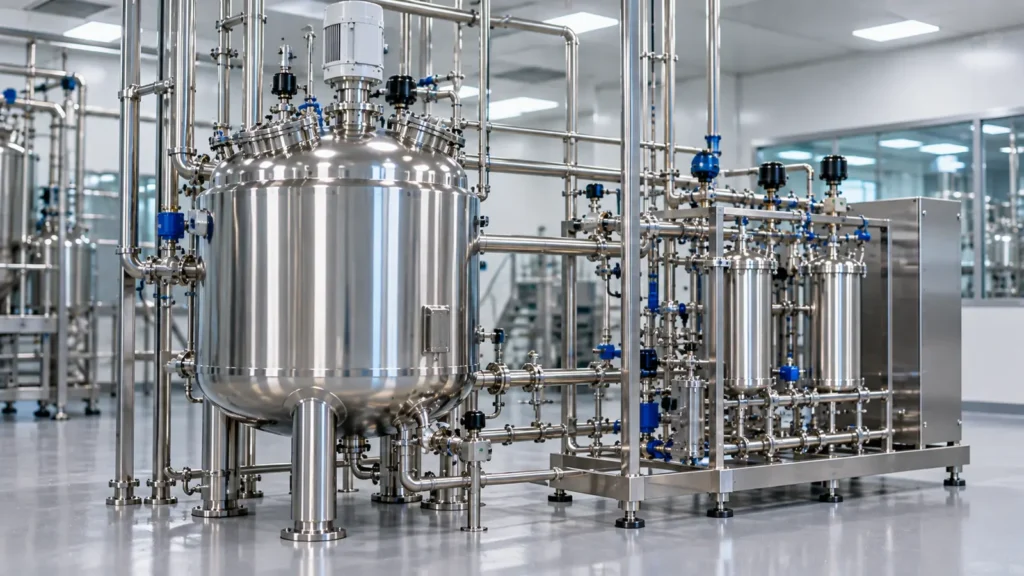
Product contact parts in SS 316L, mirror polished and electropolished, give a surface that is easier to clean and easier to sample. Layout matters as much as finish. Slopes, outlet position, valve type and the length of branches decide whether liquid drains and whether a cleaning agent reaches every surface. Our guide to controlling dead legs and biofilm risk in CIP/SIP skid design goes through the design rules in detail, and decoding ASME BPE standards for sterile manufacturing vessels explains the standard behind many of them. For material choices beyond SS 316L, see material selection for aseptic holding tanks.
Spray coverage and the riboflavin test
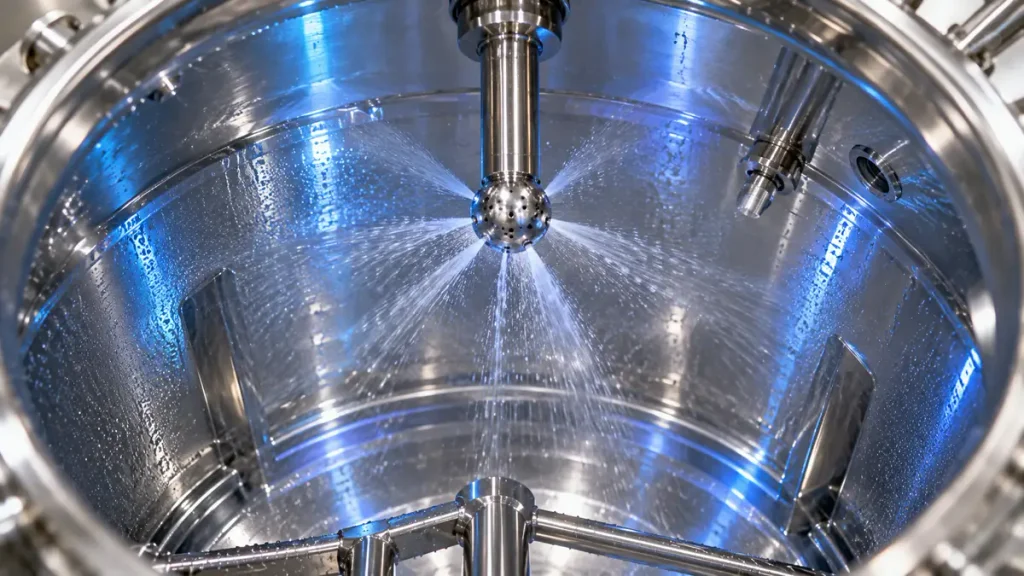
A riboflavin coverage test is a practical way to check that a spray device wets the vessel surface. A riboflavin solution is applied, the vessel is cleaned, and the interior is inspected under UV light for areas that still fluoresce. It is a coverage check, not a residue limit. It shows where the spray does not reach, which lets the team correct the spray device or cycle before the formal protocol begins. Esteril includes a riboflavin test in its cleaning validation scope.
Controlled and recorded cycles
Cleaning parameters such as time, temperature, flow and chemical dosing need to be repeatable and recorded. A PLC panel with time and temperature control, a printer and alarms, together with provision for online acid and alkaline dosing, gives the validation team a defined process to challenge. Annex 15 paragraph 10.4 expects the validation to cover the normal operating range of an automated process, so the range has to be set deliberately in the design stage. Where cycle data is held electronically, the data integrity questions in our post on 21 CFR Part 11 and Annex 11 for process skid automation apply. Documented output from cleaning and sterilisation cycles supports both the protocol and the batch record.
Cycle design also affects the economics of validation. A shorter, tighter cycle has fewer variables to defend, which is covered in how to optimise cycle times in automated CIP systems.
A seven-step sequence for cleaning validation
The order below follows Annex 15, section 10, and works for new equipment as well as for changes to existing lines.
- Design the cleaning procedure. Define the method (automated CIP, manual, or a combination), the cleaning agents, the parameters and the dismantling steps. Manual cleaning needs particular care, because Annex 15 paragraph 10.15 expects the validation to address the variability a person introduces.
- Select the worst case. Annex 15 paragraph 10.5 expects a worst case approach. Choose products by solubility, potency, toxicity and cleanability, and choose equipment locations that are hardest to reach or drain.
- Set acceptance limits. Limits come from a toxicological evaluation, including health-based exposure limits where applicable (paragraph 10.6). For macromolecules and peptides, which degrade or denature in cleaning, paragraph 10.6.1 recognises that the residue may not be found as the original molecule. Paragraph 10.6.2 allows parameters such as total organic carbon (TOC) and conductivity to be used as representative measures when justified.
- Choose sampling and analytical methods. Use swab and rinse sampling where each fits, define the locations, and show recovery (paragraphs 10.11 and 10.12). Analytical methods must themselves be validated (paragraph 9.1).
- Define hold times. Set the permitted time between use and cleaning (dirty hold) and between cleaning and next use (clean hold) (paragraph 10.8). Cover campaigns where the same product is made in succession (paragraph 10.9).
- Run the protocol. The number of runs is based on risk and does not have a fixed minimum in the guideline (paragraph 10.13). Include microbial and endotoxin testing where the product risk calls for it (paragraph 10.7).
- Report, approve and verify on an ongoing basis. Keep the equipment under change control, and use periodic verification so that drift in the process is visible before it becomes a deviation.
Who is responsible: supplier or manufacturer
The manufacturer owns cleaning validation. The supplier owns the evidence about the equipment. Mixing the two causes late delays.
| Item | Manufacturer | Equipment supplier |
| Cleaning procedure and agents | Defines and approves | Advises on cycle capability and materials |
| Product worst case and acceptance limits | Defines | Not involved |
| Hygienic design, finish, drainability | Reviews in design qualification | Designs, documents and demonstrates |
| Spray coverage check | Witnesses | Performs at FAT where agreed |
| Cycle recipe, parameters and records | Approves | Programmes, tests and documents |
| Residue recovery and analytical method | Owns | Not involved |
| Validation protocol and report | Owns | Provides inputs |
The split fits the wider qualification path described in FAT and SAT for pharmaceutical process skids and in our process skid procurement checklist.
Evidence to request from the equipment supplier
Ask for these items in the quotation stage, so that they are priced and scheduled.
- Material certificates and finish records for product contact parts.
- Drawings that show slopes, outlets and branch lengths, so that drainability can be reviewed.
- Spray coverage or riboflavin test records from FAT.
- The cycle recipes, the parameter ranges and the alarm settings.
- Documented output of cleaning and sterilisation cycles from FAT.
- Software and automation documentation, including the design specification and the test records.
- Calibration records for the sensors that control the cleaning parameters.
Our URS guide for a sterile manufacturing vessel skid shows how to write these requests into the URS.
Common pitfalls
- Validating the visible. Annex 15 paragraph 10.2 states that a visual check is not sufficient on its own.
- Ignoring hold times. A cleaned vessel that waits for days before use is a different risk from one used the same shift.
- Choosing the wrong worst case. The hardest location may be a valve seat or a sample port, not the vessel wall.
- Treating the supplier’s FAT as the validation. FAT shows that the equipment works as designed. It does not prove the manufacturer’s procedure with the manufacturer’s product.
- Changing the cycle after validation. Any change to a validated parameter needs a documented assessment.
Frequently asked questions
What is the difference between cleaning validation and cleaning verification?
Cleaning validation proves that a defined procedure removes residues to the acceptance limit across the normal operating range. Cleaning verification confirms the result of a single cleaning event. Annex 15 defines both, and they are used together in most plants.
Is a visual inspection enough?
No. Annex 15 paragraph 10.2 states that visual inspection alone is not sufficient. It is a necessary check before use, but quantitative methods such as swab and rinse analysis are expected for validation.
How many validation runs are required?
The guideline does not set a fixed number. Paragraph 10.13 says the number of runs is based on risk. Many manufacturers define the number in their own validation policy and justify it in the protocol.
How does cleaning validation work for peptides and other biologics?
These molecules can degrade or denature during cleaning, so the original molecule may not be present as a residue. Annex 15 paragraph 10.6.1 recognises this, and paragraph 10.6.2 allows parameters such as TOC and conductivity to be used as representative measures when they are justified. Our post on a peptide injectable formulation vessel covers the equipment side of these projects.
Who is responsible for cleaning validation, the manufacturer or the equipment supplier?
The manufacturer. The supplier provides the equipment, the design documentation, the cycle programme and the FAT and SAT evidence that the manufacturer relies on in the protocol.
Does automation change the validation approach?
It changes what has to be proven. Annex 15 paragraph 10.4 expects the validation to cover the normal operating range of an automated process. The recipe, the sensors and the electronic records then become part of the validated state. The In-Situ CIP/SIP system guide and our clean-in-place guide explain how the systems are built.